
Story · Puranic tradition
A king made himself almost impossible to kill. His son disagreed with him anyway.
Hiranyakashipu arranged his life so that nothing could touch him. What he could not arrange was agreement — and the disagreement lived under his own roof.
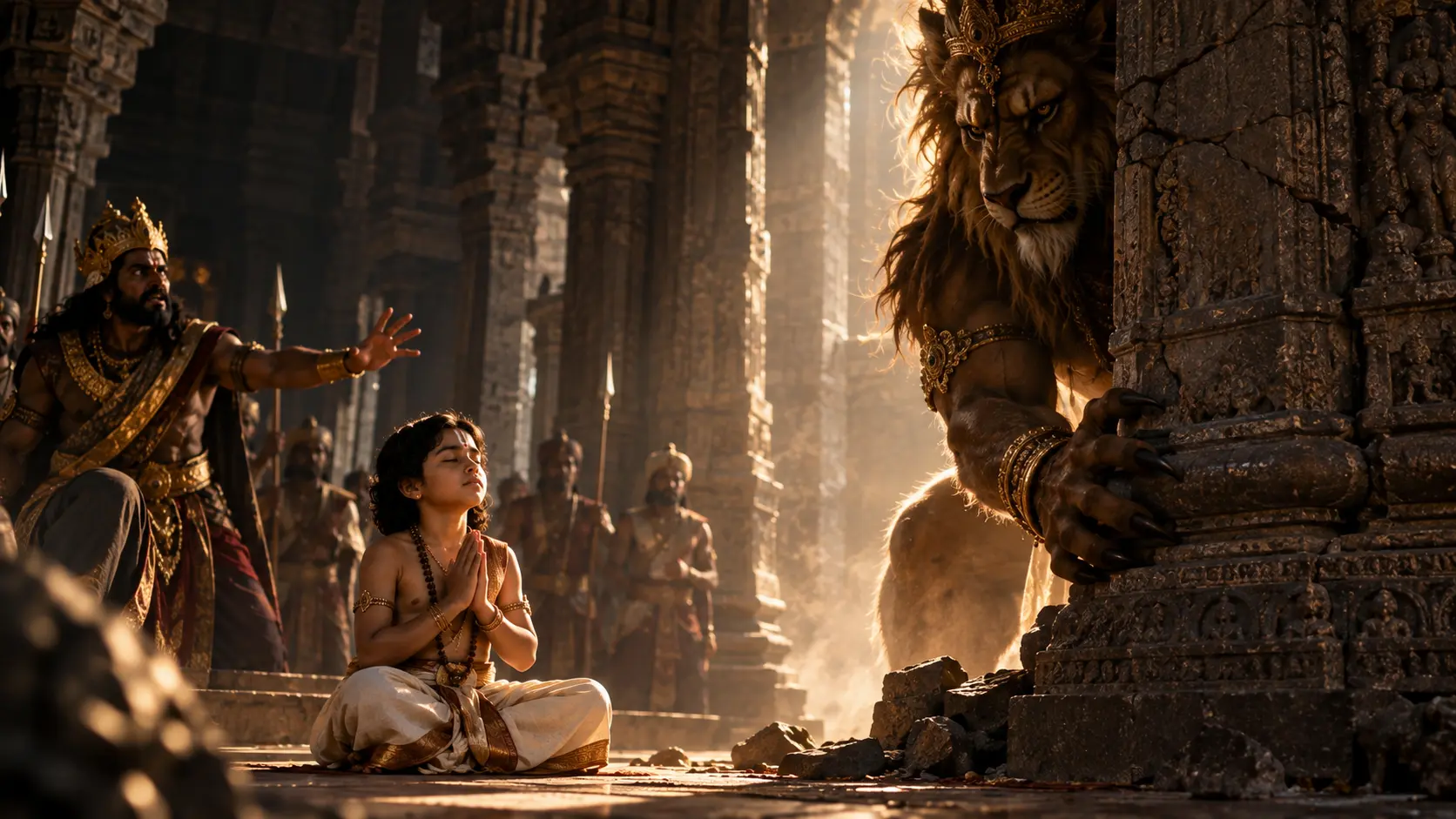
He had protected himself against every way of dying he could name. His son was not on the list, because a list is for enemies — and family is supposed to agree.
The story
A man who rebuilt the world around his fear
Hiranyakashipu's hatred of Vishnu had an origin the tradition is clear about: his brother died at Vishnu's hands. The grief did not soften. It set, like mortar, and became a project.
If Vishnu could reach him through the world, then the world itself was the problem. He withdrew and subjected himself to austerities so severe that the sources treat them as extraordinary even among ascetics. And it worked. He came back with what he had gone for — a set of conditions, agreed and binding, under which he could not be killed.
The conditions have been preserved in detail. He asked not to be killed by any being created by Brahma. Not inside a building or outside it. Not during the day or during the night. Not on the ground or in the air. Not by any weapon. Not by a human, an animal, or any living or nonliving thing.
Read the list twice and you notice it is a list. A list can be thorough. It cannot be complete.
The household
With mortality managed, a ruler of that kind turns to the remaining disorder in his kingdom. Mostly, there is none. Agreement is total, because disagreement has been made dangerous.
Except at home. His own son, Prahlada, was devoted to Vishnu, and did not keep it quiet. This is where the story stops being about monsters and becomes about something more recognisable: a father who cannot understand why the one person who should reflect him back to himself refuses to.
From the father's side, the boy's devotion is not a private matter. It is allegiance — open, cheerful allegiance to the very power Hiranyakashipu had rebuilt his entire existence to be safe from. Spoken by his own child and heir, in his own halls. It is not rebellion in any ordinary sense; the boy does not raise an army or make a claim. He simply will not say what he is required to say.
So the machinery of the household turns on him. First the reasoning, almost administrative: send him back through schooling, correct the error. The teachers fail. Then stronger measures, and the sources describe attempts on the boy's life with a matter-of-factness that is hard to read slowly. He survives each one.
The pattern matters more than any single incident. Coercion can make a child sit in the right room, wear the right clothes, use the right words in the wrong tone. It cannot make him mean it. Each failure teaches the father the same lesson — that obedience without belief is worth nothing — and he refuses to learn it, because the alternative is to admit the boy is right.
The pillar
The end comes through a question, as these things do. Where is your Vishnu now? Is he in this hall? Is he here, in front of you? The exchanges are paraphrased here, but the shape is stable across tellings: the father demands a location, and the son declines to give him one, because there isn't one. There is nowhere Vishnu is not.
In exasperation — the sources suggest genuine, contemptuous incredulity — he gestures at a pillar of the palace. Is he in this? In this column of stone, holding up your grandfather's roof?
He is. The father strikes the pillar.
What comes out of it is the most uncanny arrival in this entire tradition. Narasimha — not a man, not a beast, a form that fits no category the king's protections were written around. The list had been drawn up against everything with a name. This thing standing in the wreckage of the pillar has the terrible property of being describable only by what it is not.
The conditions, tested
What follows has the grim logic of a contract being executed. Not by any being created by Brahma. Not a human, not an animal. Not on the ground or in the air — the tradition places the king across the being's lap. Not inside, not outside — at a threshold, the boundary that belongs to neither. Not by day, not by night — at twilight. Not by any weapon — by claws, which are part of the body and not a weapon at all.
It should be said plainly: the verses that record the boon do not narrate the death in that same tidy sequence. The categories answer each other beautifully in the popular telling, and versions differ in how much of it they stage. But the broad outcome is not in doubt in any telling.
There is a coda, and it is not a relief. The being does not immediately calm. The sources describe a form still burning with rage after the kill, the gods themselves keeping their distance. It is Prahlada, the child nobody could frighten, who approaches it — and is received.
Why it matters
Dharma Pitch editorial reflection
Power can command behaviour. It cannot manufacture conviction — and once obedience is forced, it can no longer tell the two apart.
Hiranyakashipu secured himself against every enemy he could name. What undid him was in his own house, saying no, quietly and forever.
Source & Context
The narrative is developed at length in the Bhagavata Purana and appears in other Puranic sources with differences in detail, sequence and tone.
The list of boon conditions above follows the Bhagavata Purana's account and was checked against it. The staging of the death — the threshold, the lap, the twilight, the claws — is traditional, but not every familiar detail appears together in the verses that list the conditions, so versions should not be treated as interchangeable.
The account of Hiranyakashipu's brother's death at Vishnu's hands is part of the traditional background for his hostility; its emphasis varies between sources.
Narasimha is one of the forms of Vishnu recognised in Vaishnava tradition, with substantial devotional, sculptural and ritual traditions attached. Those are sources in their own right.
This retelling gives the widely shared outline. It does not quote any text, cite chapter and verse beyond the source note, or adopt a particular sectarian interpretation.
Sources checked
- Bhagavata Purana7.3.35–38 (Hiranyakashipu’s boon conditions)
An editorial retelling based on the Prahlada narrative in the Bhagavata Purana and related Puranic sources. The boon conditions were checked at Bhagavata Purana 7.3.35–38; nothing is quoted, and details elsewhere vary between versions.
What it raises
- 01
A court learns quickly to agree with its king. How would anyone inside one ever find out how much of the agreement is fear?
- 02
Hiranyakashipu asked for protection against every way of dying. What was all of that protection for, in the end?
- 03
Prahlada never argues his father out of anything. Where does a conviction like his come from — and would yours survive that house?
Explore further
Devotion and practice
The Bhagavata treats Prahlada as an example of devotion held under pressure rather than in comfort.
Entry in preparationPower and its limits
Read alongside the Ramayana's account of a throne refused, and the Mahabharata's account of authority that cannot resolve its own obligations.
Read the entryDharma
A father's claim, a king's command and a son's conscience are in direct conflict here — all of them describable in the vocabulary of dharma.
Read the entry