
Deeper read · Mahabharata
Dharma when every available choice is wrong
The Mahabharata is not a book about people who fail to do their duty. It is a book about what happens when duties cannot all be met at once.
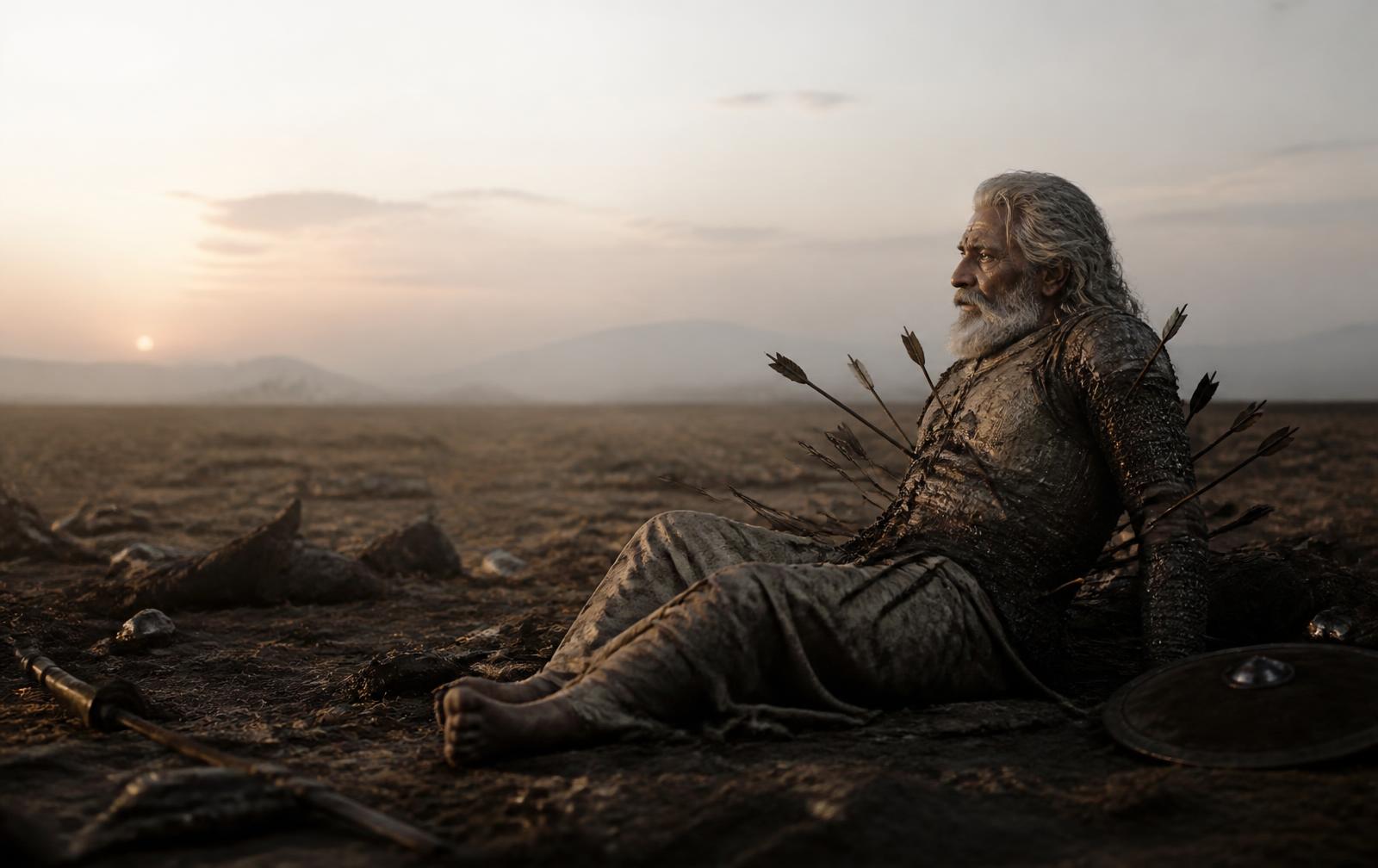
The hardest choices do not arrive as right against wrong. They arrive as two people, promises or duties that each have a legitimate claim on you — and whichever you honour, something real is damaged.
The argument
No clean hands
Here is an uncomfortable place to start: sometimes every choice in front of you leaves a moral remainder. You can act for a good reason and still cause harm. You can refuse to act and still cause harm. There are situations — most people who have led anything, or loved anyone through a crisis, have met at least one — where innocence is simply not on the menu.
The Mahabharata knows this intimately. It is often described as a war between a righteous side and a wrongful one, and at a distance that is true. Up close, the epic repeatedly refuses its own characters the comfort of clean hands. The winning side does things it cannot fully justify. The losing side contains people of real integrity. Decent, serious, dutiful people find themselves in positions where every door opens onto a loss.
This is not an essay about Arjuna's collapse on the battlefield — we have written that piece, and it is about what happens when a capable person freezes. This one is about what comes after the freezing. The moment when the decision still has to be made, the values still collide, and someone has to carry the result.
When a good vow becomes a cage
Start with Bhishma, because almost every hard case in the epic runs through him. As a young man he made a vow of terrible generosity — renouncing the throne and marriage so that his father could have the wife he wanted. It was a sacrifice. It was sincere. It was honoured for a lifetime.
And then the years turned it into something else. The vow bound him to whoever sat on the throne of Hastinapura, which meant that when the throne began to be used badly, the one man with the standing to stop it had already promised not to. When Draupadi was dragged into the assembly and staked like property, Bhishma was present — and paralysed, not by cowardice but by the structure his own sacrifice had built around him.
The epic does not call his vow wrong. It does something more unsettling: it lets a rightly kept promise become one of the mechanisms of a catastrophe. This connects to how we read Bhishma elsewhere on Dharma Pitch, but the point here is narrower and colder. A commitment can be good at the moment it is made, sincerely held for decades, and still become the thing that prevents you from intervening when intervention is most needed. Faithfulness and adequacy are not the same virtue.
The question nobody in the hall could answer
Then there is the assembly itself, and the question Draupadi puts to it. Yudhishthira has lost everything at dice — his kingdom, his brothers, himself. Then he stakes her, and loses. And she asks the hall a question of extraordinary precision: if he had already lost himself, by what right could he stake her?
It is a legal question and a moral one at once, and the most learned men in the world are sitting in that room. Bhishma himself is reported to say, in effect, that dharma is subtle — that he cannot resolve it. However the exact wording is taken, the scene's force is unmistakable: the guardians of the tradition, faced with a question that exposed a contradiction inside it, could not or would not answer.
That silence is one of the most important moments in the epic. It tells you the difficulty is not a failure of intelligence or learning. The wisest people present are defeated not by wickedness but by a genuine collision — between the law of the wager, the status of a wife, the authority of a king, and the plain human wrong unfolding in front of them. Draupadi's question still stands in the text like a crack in a wall. The epic leaves it there.
Truth against protection
Yudhishthira is the epic's embodiment of truthfulness — it is what he is for. And yet his truthfulness does not protect him from the dice hall, where his honesty about his obligations is exploited by people with none. And late in the war, truth itself collides with survival: urged towards a half-truth about the death of an elephant named Ashwatthama to break the invincible Drona's will to fight, he says the words, with a qualification spoken too quietly to function as one.
The point is not 'Yudhishthira lied', as if the epic had finally exposed a hypocrite. The point is that truth-telling — the clearest duty he has — is set against the duty to protect his own people in a war that will otherwise consume them, and he cannot fully serve both. Even the text treats the moment as a fall; tradition holds that his chariot, which had ridden slightly above the ground, dropped to earth. Something was genuinely lost. That is precisely the mark of these situations: the best available action still carried a cost, and the cost was real.
Why dharma keeps colliding with itself
It helps to see why these collisions are structural rather than accidental. Dharma in the epic is never one thing. It is role-based — what a king owes, what a son owes, what a teacher owes. It is relational — what you owe this particular person because of your history with them. It is ethical — what truth and non-harm demand of anyone. And it is situational — what this moment, this war, this hall requires. Any one of these is navigable. The epic's characters live inside all of them at once.
Bhishma's duty to his vow, his duty to the throne, his duty to justice and his duty to the woman standing in the hall do not sum to an answer. They sum to a man sitting in silence. That is what a collision of dharmas looks like from the inside, and it is why the epic cannot hand us an algorithm. There is no formula that takes four legitimate claims and outputs a clean act.
But — and this matters as much — none of this means that all choices are equal. The Mahabharata's complexity is not moral relativism in old clothing. Harm still counts. Motive still counts. Whether you deceived yourself about your motives counts. The epic contains clearly worse choices, made for greed and spite, and it does not shrug at them. 'Dharma is subtle' is a warning about how hard the work is, not an excuse to skip it.
After the decision
Here is our own reading, offered as Dharma Pitch interpretation rather than as anything the epic states as a rule. Moral maturity, in this text, looks less like keeping your hands perfectly clean and more like three harder things: seeing the cost clearly before you choose, choosing without lying to yourself about why, and remaining responsible for what follows after.
That last part is the one we most want to avoid, and the epic will not let it go. The war is won, and then it is mourned — at length, in detail, by the victors. Whatever was necessary, its consequences were not dissolved by its necessity. Good reasons are not a solvent for harm.
A modern version, deliberately ordinary: a leader has to close a service that is failing. Keeping it open drains the money that keeps everything else alive; closing it abandons the small group of people who depend on it most. There is a genuinely better option here — complexity is not an excuse — and it will still leave real people worse off, and the person who decides will know their names. The Dharma Pitch suggestion is only this: make the decision, and then stay in relationship with its cost. Do not use the good reason as a way of never thinking about the names again.
This is where the pieces on this site connect. Arjuna shows what it is to freeze when values collide; this essay is about acting anyway. Shreyas and preyas — the genuinely good against the merely pleasant — stops helping when both options are painful. And karma matters here precisely because consequences persist: what you set in motion does not disappear because your motives were decent.
Why it matters
Dharma Pitch editorial reflection
Most ethical instruction assumes the difficulty is doing the right thing once you know it. The Mahabharata keeps placing the difficulty one step earlier: knowing it at all, when legitimate duties pull apart. That is a more honest picture of adult life.
Ethical seriousness includes what happens after the decision. The epic's victors mourn what their victory cost, and the text does not treat their good reasons as erasing it. Neither should ours.
Source & Context
The episodes described — Bhishma's vow and his conduct in the assembly, Draupadi's question about the wager, and Yudhishthira's half-truth about Ashwatthama the elephant during Drona's last battle — are all from the Mahabharata itself. They are described here in outline, without quotation and without verse citation, and the wording of key exchanges is paraphrased.
The framing of these episodes as a sustained study of colliding duties is a well-established way of reading the epic, but it is an interpretation, and it is presented as one. The final section — moral maturity as seeing cost, choosing without self-deception and remaining responsible — is Dharma Pitch editorial synthesis, not a claim the epic makes in those terms.
The Mahabharata is a vast text with a long compositional history and does not speak with one voice; other readings of every episode touched here are entirely reasonable.
A Dharma Pitch interpretive essay, clearly distinct from the epic's own statements. Episodes are described in outline without quotation or verse citation, and the readings offered are one of several defensible approaches to the text.
What it raises
- 01
Think of a time when every option in front of you carried a real cost. What did you tell yourself afterwards — and was it true?
- 02
What is the difference between accepting moral complexity and using it as cover for what you already wanted to do?
- 03
Is there a decision in your past whose cost you have quietly stopped counting?
Explore further
Dharma
The word carrying several senses at once is precisely why these conflicts are possible.
Read the entryArjuna's crisis
The Gita is the moment the epic stops and examines this problem directly.
Read the entryDecision-making
A contemporary Dharma Pitch framework for situations with no clean option — ours, not the epic's.
Read the entry