
Deeper read · Bhagavad Gita
Why the Bhagavad Gita begins with a man who cannot act
Before it offers a single idea, the Bhagavad Gita shows us a highly capable person who cannot act. That opening is not a preamble. It is the reason the philosophy exists.
A person can prepare for a decision for years and still find, when the moment arrives, that the body refuses to move. The Bhagavad Gita begins there.
The argument
The chariot stops
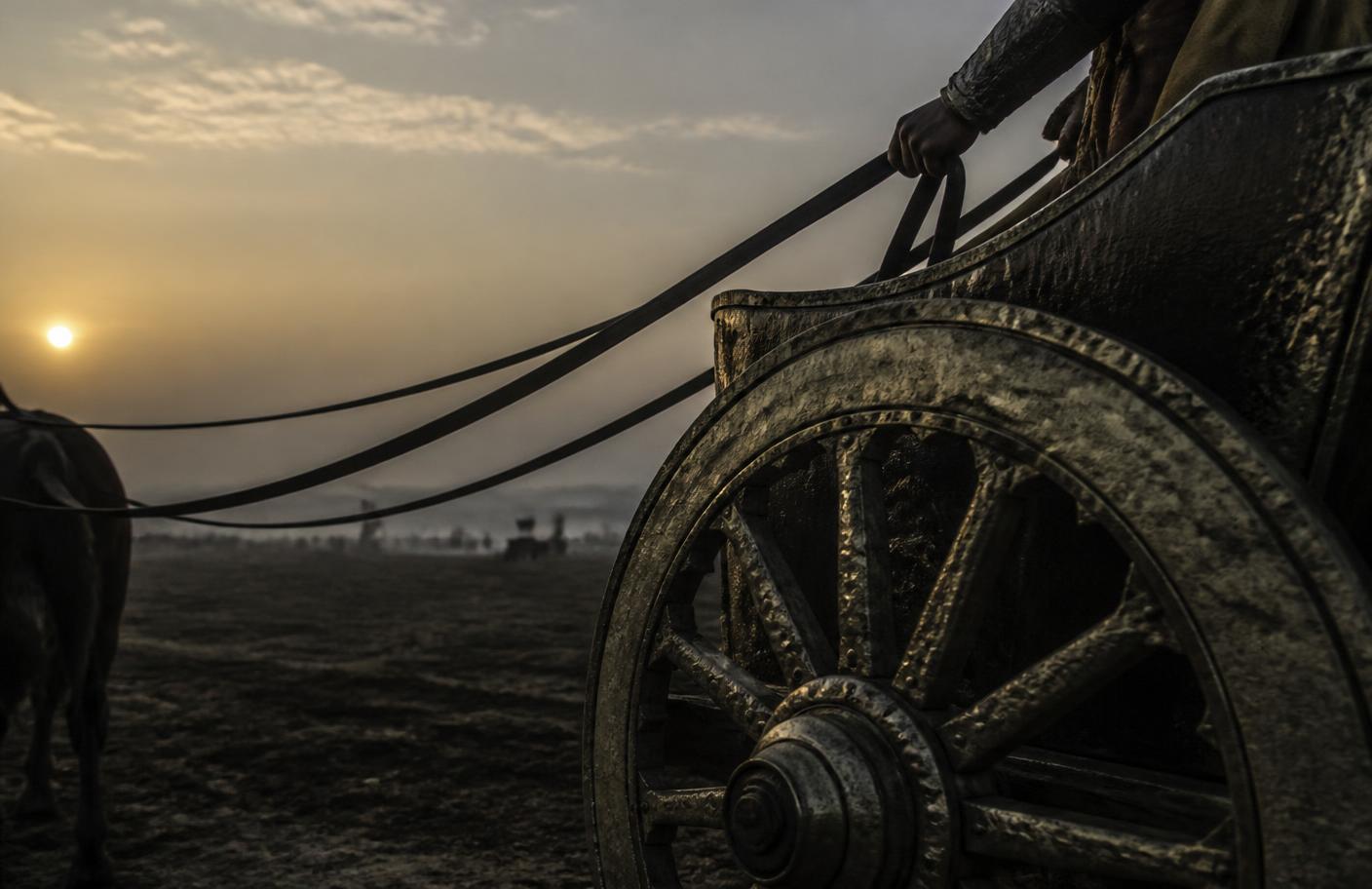
The Mahabharata's great war is assembled and about to begin. Arjuna, the finest archer on the field, asks Krishna to place their chariot between the two armies. He wants to look at the men gathered to fight.
What he sees is not an enemy in the abstract. He sees his teachers and elders. He sees cousins, uncles, grandfathers, sons, grandsons, fathers-in-law, friends and companions — people he grew up under and alongside, arranged on both sides, ready to kill and be killed.
And something in him gives way. The text is unusually concrete about this. His mouth goes dry. His body trembles. His hair stands on end. The famous bow slips from his hand. He feels burning and cannot stand. He tells Krishna, in effect: I will not fight.
Not cowardice, and not fear of dying
It matters, before anything else, to be clear about who is breaking down. This is not a reluctant conscript. Arjuna is one of the most formidable warriors of his age, a man who has won a bride by outshooting a moving target, faced armies, and spent thirteen years of exile preparing for exactly this confrontation. He is not afraid of dying. He says, near the start of his refusal, that he would rather die in this battle unarmed and unresisting than live by killing these men.
His problem is different, and harder. Every action available to him now violates something he values. Fight, and he kills the teachers who trained him and the kin whose blood runs in his own children. Walk away, and he abandons justice for his brothers, cedes the field to those who cheated them, and lets a lifetime of wrongs stand. Retreat into the forest, and he commits violence of another kind — against his own vows, against the people counting on him.
He is not paralysed because he cannot see the options. He is paralysed because he sees them all too clearly, and each one costs something he cannot bring himself to pay. This is the hardest class of decision there is: not a choice between good and evil, but a collision between goods — kinship, duty, justice, loyalty, order, consequence — where honouring one means betraying another.
That is what the Gita chooses to open with. Not a soldier failing at war, but a man for whom the war has stopped being a question of skill.
The body speaks first
Before Arjuna argues, his body announces the crisis. The dryness, the trembling, the burning skin, the bow that will not stay in his grip, the legs that will not hold him — the first chapter records these closely, the way an observer standing beside the chariot might.
It is worth pausing on what this detail tells us about the text. The Gita does not treat the crisis as an argument that happens to be felt. It presents a whole person: reasoning, trembling, refusing. Competence does not protect anyone from this. Arjuna has trained his whole life for the moment, and when it comes his certainty collapses anyway — precisely because he is the one who can see what the consequences actually are.
Sometimes the person who finds action hardest is the person who understands the situation best. That is not a weakness in Arjuna. It is the human truth the opening is built on.
Why the teaching had to begin here
Philosophical works usually begin with a question. This one begins with a person who cannot function, and that changes what the dialogue has to do.
Arjuna does not lack information. He lacks a way to act that he can live with. His existing frameworks — the honour of a warrior, the claims of family, the demands of justice — are all still intact. That is the problem. Each framework gives him an instruction, and the instructions contradict. No amount of courage resolves a contradiction between values. Something has to be thought through differently.
Which is why Krishna does not begin by answering him. He begins, at the start of the second chapter, by rebuking him — sharp words about a dejection unworthy of him, arising at a moment that does not lead to heaven and brings no fame. Then, only then, does the teaching begin, and it unfolds layer by layer: what a person is beneath the loss of everything they can see; what action means when it is stripped of attachment to results; knowledge, discipline, devotion, the divine nature itself. These are not six answers to one question. They are successive attempts to give a man in crisis a ground to stand on.
The simplest reading — Krishna tells him to fight, because it is his duty — flattens all of this. The dialogue's argument is long and many-sided precisely because the crisis is not simple. And the major traditions of interpretation have never agreed on the hierarchy of what Krishna teaches: for some, the way of knowledge stands first; for others, devoted action; for others still, love and surrender. Reading the Gita means inheriting that disagreement, not escaping it.
A battlefield, and also more than one
Keep two things true at once. In the text, this is a real battlefield, at the edge of a real war, with real people about to die. The Gita is not detached from the violence it sits inside; its opening question is whether this specific killing can be justified, and its answer is argued from inside a warrior's obligations, not from a study.
Later readers have also read the scene symbolically — the field as the world, the armies as competing drives, the choice as every choice. There is something to that reading; the dialogue's logic does travel. But the symbol did not come first. The scene works as a metaphor because it works as a scene. Hold the levels separately and the text is richer; collapse them, and it becomes either a war poem pretending to be philosophy or a philosophy ashamed of its setting. The Gita is neither.
Where we stand when we read it
Few of us will ever stand between two armies. But the shape of Arjuna's situation is not exotic, and it is worth naming carefully — these comparisons are ours, not the text's.
Think of a senior leader who must decide redundancies: people she respects will lose their livelihoods, yet delaying may sink the organisation that employs hundreds. Or a doctor choosing between two treatments, each of which carries a harm, knowing that declining to choose is also a choice. Or a family member deciding whether loyalty requires silence, or truth, and fearing that the honest answer destroys the relationship that made the question bearable. In each case the difficulty is not weakness of character. It is that every available action violates something real.
The Gita's opening says: this is where serious thinking starts. Not from certainty, not from a clean conscience, but from the moment the old frameworks stop producing an action you can live with. That a text this influential chose to begin not with an idea but with a breakdown is worth sitting with.
Why it matters
Dharma Pitch editorial reflection
The Gita does not begin with certainty. It begins with a capable person, at the point of action, admitting he does not know what to do — and everything after exists because of that admission.
Arjuna's collapse is not cowardice. The hardest decisions are rarely between good and evil; they are between goods, and seeing the consequences clearly often makes acting harder, not easier.
Source & Context
The Bhagavad Gita sits within the Bhishma Parva of the Mahabharata, at the war's opening. Chapter 1 establishes the crisis: Arjuna surveys both armies, the physical collapse, and his stated reasons for refusing to fight. Chapter 2 opens with Krishna's rebuke, and the teaching proper begins from there. It also circulates independently of the epic, which affects how it is read.
The philosophical layers named here — self, action, attachment, knowledge, discipline, devotion, divine nature — are the terrain the text moves across, but the major traditions read their relationship differently: Advaita, Vishishtadvaita and Dvaita commentators each give a different teaching pride of place, and modern readers, including political ones, have read it variously again.
This piece quotes nothing and cites no chapter or verse beyond the structure above. Arjuna's state and arguments are paraphrased from Chapter 1 and the opening of Chapter 2; the text's own formulations are more compressed and more precise. We have applied no modern clinical category to Arjuna, and the contemporary examples in the final section are Dharma Pitch's, not the Gita's.
Sources checked
- Bhagavad GitaChapter 1 and 2.1–3
A Dharma Pitch deeper read checked against Bhagavad Gita Chapter 1 and the opening rebuke at 2.1–3. Nothing is quoted. The piece distinguishes the text's opening chapters from later philosophical interpretation, avoids applying modern clinical categories to Arjuna, and does not adopt any one commentator's reading.
What it raises
- 01
When your existing values each give you a different instruction, where does a person actually look for a way to act?
- 02
Does the Gita answer Arjuna's objections, or reframe them until they no longer apply — and is there a difference?
- 03
If the dialogue could only happen because of the crisis, what does that say about where serious questions come from?
Explore further
Karma
Action and attachment to its results — the Gita's most cited contribution, and its most flattened.
Read the entryDharma
Arjuna's crisis is describable as a conflict of dharmas, which is exactly why a single translation of the word will not serve.
Read the entryCompeting duties
The Mahabharata sets up this problem long before the Gita states it.
Read the entry