
Explained · Concepts
Why Dharma resists translation
Religion, duty, law, righteousness, order: each catches something in the word, and each leaves something important behind.
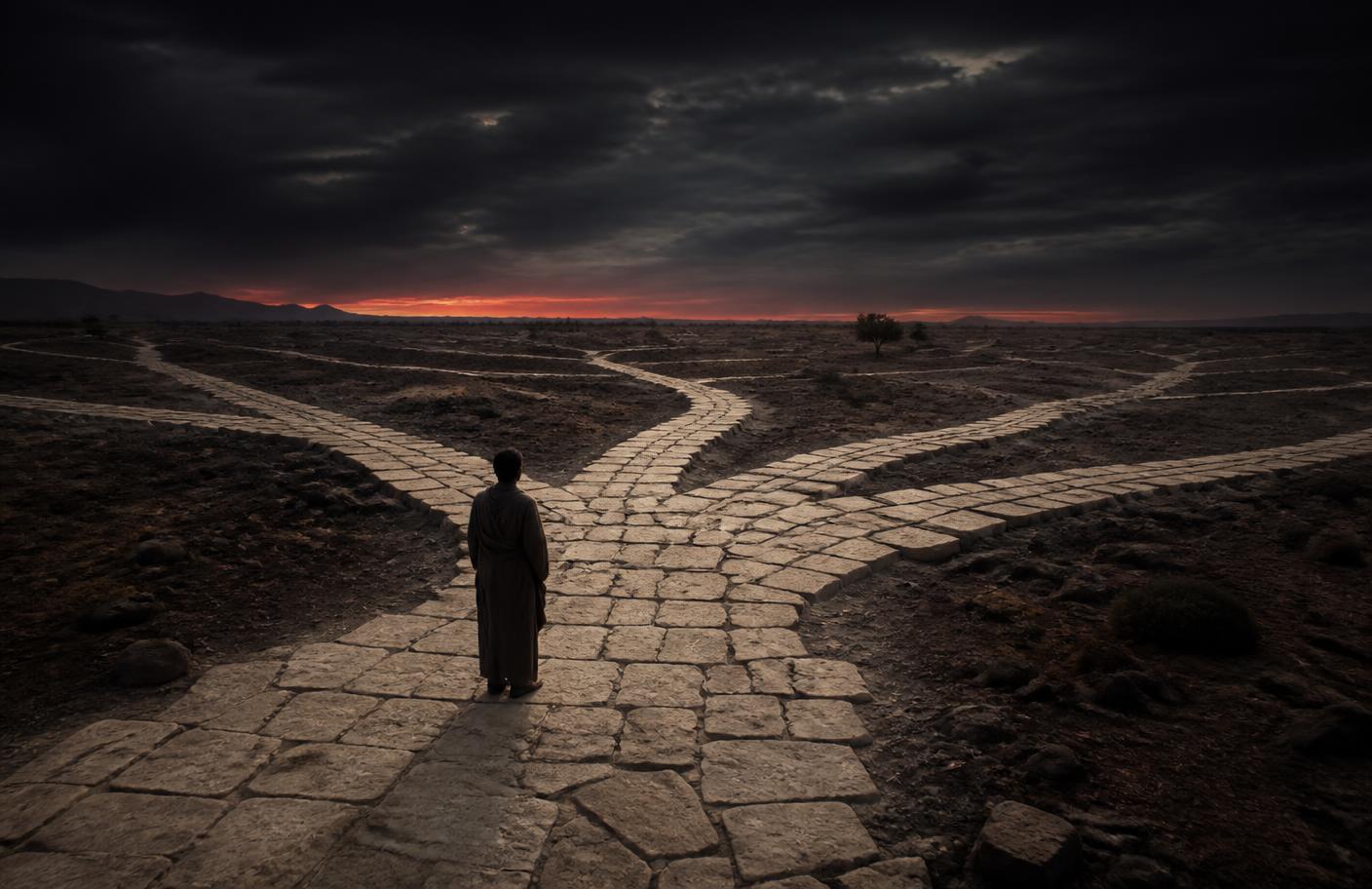
Dharma appears in stories of kings and guests, family duty and social order, personal conduct and the character of things. No single English word can carry all of that.
The idea
A word that keeps slipping away
Ask what dharma means and you will get several confident answers. Duty. Religion. Law. Righteousness. Ethics. Each of them is offered sincerely, each of them is genuinely used by translators, and each of them fails in an instructive way. The word does not resist translation because it is mystical. It resists translation because the English words we reach for were built to answer narrower questions.
Watch the failures one by one. 'Religion' implies a bounded system of belief you can join or leave — yet the sources apply dharma to things that have nothing to do with belief: the obligations of a ruler, the treatment owed to a guest, the way fire behaves as fire. 'Law' suggests something written down and enforced, when much of the literature treats dharma as unwritten, contested and situational. 'Duty' gets closest in some passages, but it smuggles in the idea of a burden imposed from outside, which is often precisely not the point.
The Sanskrit root most often pointed to is dhṛ — to hold, to support, to sustain. It is a clue, not a definition. But it is a good clue: it suggests that dharma, at bottom, concerns what holds something up. What upholds a person, a household, a kingdom, a promise, a world. That is a wide field, and the word's wide range follows from it.
The meaning moves with the situation
The surest way to learn the word is to watch it at work, because in use it is rarely abstract. A father standing between his feuding sons has a dharma. So does a doctor deciding how much truth a frightened patient can carry. So does a soldier who has sworn an oath he now regrets, and a friend who has been told a secret that protects one person by harming another.
In some of these cases the word is doing the work of role and relationship — what is yours to do because of who you are and whom you answer to. In others it is doing the work of moral judgement — what is right here, when the roles do not settle it. Elsewhere in the literature it names something larger still: the order that sustains things, the grain along which a life or a society can run without splintering.
None of this is one timeless definition handed down unchanged. Vedic ritual texts, the Upanishads, the epics, the Dharmashastra legal literature and later devotional traditions all use the word, and the emphasis shifts with each — from cosmic and ritual order, through social and personal conduct, toward liberation and devotion. Buddhist and Jain traditions carry their own technical senses too. Anyone who offers you the single ancient meaning of dharma is tidying up a history that is not tidy.
Where the word earns its keep
Dharma becomes most visible not when the right thing is obvious, but when two right things collide. This is why the Mahabharata returns to the word so relentlessly. Its characters are rarely choosing between good and evil. They are choosing between goods: loyalty against justice, truth against protection, a promise kept against the destruction keeping it will cause. A vow can be dharmic in one sense and ruinous in another, and the epic knows it.
Bhishma holds to a lifelong oath while the kingdom rots around it. Yudhishthira is so attached to truthfulness that the times he bends it carry enormous weight. Bharata is handed a throne he believes is not rightfully his and has to decide what fidelity requires of him now. None of these situations is resolved by reciting a definition. Each of them is the word, under load.
The literature admits this openly. There is a recurring acknowledgement that dharma is subtle — that knowing the principle does not tell you what this situation, on this day, requires of this person. Circumstance changes the answer. Later legal and philosophical writers spent centuries trying to systematise exactly this, and the fact that they produced arguments rather than a single code is itself part of the story.
A way of thinking, not a formula
So what can a modern reader do with a word this large? Here is a Dharma Pitch tool — ours, contemporary, not an ancient checklist. When a decision is genuinely hard, ask: what is mine to do here? What am I responsible for, and to whom? What am I protecting? Who bears the cost if I act, and if I do not? And what would happen if everyone in my position acted this way?
These questions do not manufacture an answer. What they do is slow the moment down long enough for its real claims to appear — the promises made, the people affected, the order at stake. That is close to what the epic characters are doing at their best: not applying a rule, but reading a situation with full attention before they act inside it. This discipline of discernment is also the ground of VIVEKA, our modern decision framework, which is built from these ideas and clearly labelled as ours rather than scripture.
The test of any translation is whether it survives the hard cases. Most English words for dharma work beautifully in the easy ones and fall apart exactly where the texts get interesting. Holding the word loosely — as a question about what upholds, here, now, for this person — keeps you honest in both.
Why it matters
Dharma Pitch editorial reflection
Translate dharma too quickly and you distort the argument before it begins. Call it duty and the Mahabharata looks like a string of failures to comply; leave room for competing claims and the real difficulty of right action comes into view.
The word's openness is not a flaw to be fixed. It is an invitation to ask, seriously, what this moment actually requires of you — which is not an antique concern.
Source & Context
Dharma appears across Vedic literature, the Upanishads, the epics, the Puranas, the Dharmashastra literature that codifies conduct, and later philosophical and devotional traditions — with the emphasis shifting in each. No single one of these sources 'defines' the word for all the others.
It matters not to say 'the Vedas say' about material that belongs to an Upanishad, an epic, a Purana or a later commentary. These are different bodies of text from different periods, and they do not speak with one voice.
The root dhṛ ('to hold, support, sustain') is a standard etymological observation, offered here as a clue to the word's range, not as a complete definition — etymology describes where a word came from, not everything it came to mean.
This piece describes usage rather than adjudicating between schools. Where traditions differ on how dharma relates to liberation, ritual or law, we note the difference instead of choosing. No texts are quoted and no verses are cited.
A Dharma Pitch explainer describing the range of a contested term. It quotes no texts and gives no citations. Where traditions differ on the meaning and scope of dharma, this piece reports the difference rather than settling it.
What it raises
- 01
When your obligations genuinely conflict — loyalty against honesty, a promise against the harm keeping it would cause — how do you decide which claim comes first?
- 02
Is what a situation asks of you something you discover, or something you decide?
- 03
Whose interests are quietly served when someone tells you, with great confidence, exactly what your duty is?
Explore further
The Dharma knowledge entry
Begin with the primary introduction to Dharma before examining the translation problem in detail.
Read the entryKarma
Action and consequence. Frequently paired with dharma in popular usage, and frequently confused with it.
Read the entryCompeting duties
Where the concept is placed under most pressure: the Mahabharata's conflicts of obligation.
Read the entryDecision-making
A contemporary Dharma Pitch framework built from these concepts — clearly labelled as ours, not as an ancient formula.
Read the entry