
Story · Mahabharata
Four brothers drank from the lake. The fifth answered the questions.
One by one, the strongest men of their age walk to the water and do not come back. When the last brother arrives, a voice he cannot see sets a condition: answer before you drink.
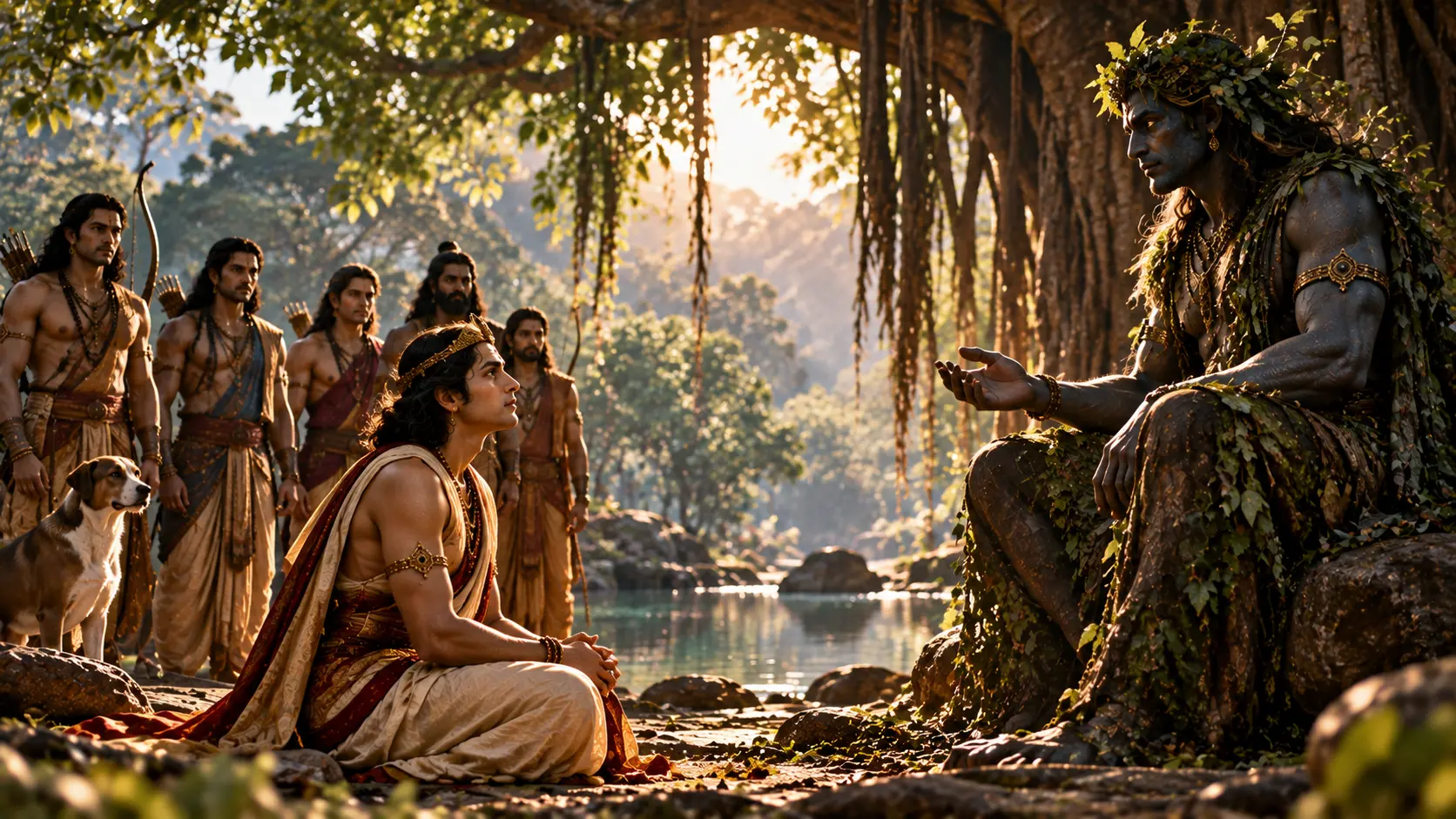
Thirst is a simple problem. The lake attaches a condition to it, and four capable men decide the condition does not apply to them.
The story
Water
By the last stretch of their exile, the Pandavas are worn down. Years in the forest have taken their toll, and on this day the heat has done the rest. Their throats are dry. They can barely talk. What they need is water, and someone needs to find it.
Nakula climbs a tree to look. In the distance he can see green — trees, and the glint of water among them. He goes. He does not come back.
Then Sahadeva is sent. He finds the lake. He does not come back either.
Then Arjuna, the greatest archer of the age. Then Bhima, the strongest man alive. One after another, the brothers walk into the forest toward water, and one after another, they disappear.
Yudhishthira is left alone with the silence.
The lake
He follows the same path his brothers took, and the forest grows strangely beautiful as he walks — flowering trees, shade, the sound of cranes and songbirds. It is lovely in a way that does not fit what has happened. Then he reaches the water.
His four brothers are lying beside the lake. Motionless. As if asleep, except that they are not asleep.
Whatever had come for them — a spirit, a poison, something in the water — it took the strongest and most celebrated men of their generation without a sound. No wound. No warning. Just four bodies at the edge of still, clear water.
And Yudhishthira is dying of thirst.
Every instinct he has says the same thing: drink first, grieve after, think later. He is half-dead. His brothers are beyond his help. The water is right there.
As he leans toward it, a voice speaks. It comes from nowhere he can see — invisible, ageless, and completely calm. The water is his, it says. He may drink. But first he must answer its questions.
His brothers heard something like this too. Each one decided the warning did not apply to him, and drank, and fell. Now the voice waits to see what the fifth brother will do.
Yudhishthira stops. And answers.
The questions
What follows is one of the strangest examinations in the epic. The unseen being asks, and Yudhishthira answers — briefly, directly, again and again. In many tellings the exchange runs to more than a hundred questions, and they do not come in any sensible order.
Some are riddles: what moves faster than the wind? The mind. What is it that never closes its eyes while everything sleeps? Time. Easy enough, if you are thinking clearly. But he is standing over his dead brothers, half-mad with thirst, and the voice does not care what state he is in.
Other questions cut closer. What makes a person wise? What makes a person rich? What is the truest happiness? Each answer he gives is small enough to carry — the kind of sentence a person could hold onto for a lifetime.
Then the voice asks the question this episode is remembered for. What is the greatest wonder on earth?
His answer, in paraphrase: every day, people see others die. Every day, the proof is in front of them that life ends. And every day, those who are still living carry on as though it will never happen to them. That — Yudhishthira says — is the greatest wonder.
He is describing his own situation exactly. Four brothers lie dead at his feet, and he is still behaving like a man who intends to live.
The voice does not praise him. It simply continues. Because the questions were never the test.
The offer
When it finally finishes, the voice makes an offer. It was the one who took his brothers, and it can give one of them back. Choose.
Bhima is the brother whose strength has carried them through everything. Arjuna is the archer the war ahead will be impossible to win without. Both are sons of Kunti — Yudhishthira's own mother. Any of the three would be the obvious choice, and no one would blame him for making it.
Yudhishthira chooses Nakula.
The voice asks him why. Not the strongest. Not the most useful in a fight. Not even his full brother.
His reasoning, in paraphrase: his father had two wives. His own mother, Kunti, still has a son — Yudhishthira himself. But Madri, his father's other wife, died long ago, and her sons were Nakula and Sahadeva. If he saves Bhima or Arjuna, one mother's line survives and the other's ends with him. He will not let that happen. Fairness does not bend just because the cost lands on him.
He has chosen the brother it costs him most to keep alive, for a reason that has nothing to do with winning anything.
The father
The voice reveals itself. It is a yaksha — and more than a yaksha. It is Dharma himself: the god of right conduct, righteousness, truth. Yudhishthira's divine father, who has been watching his son all along.
The strange warning, the riddles, the offer — it was all him. He had taken the brothers only to see, once the answers were done, which one his son would bring back. The brothers are restored. All four stand up at the water's edge.
And the examination quietly closes. In the questions, Yudhishthira showed he could think. In the choice, he showed who he was. Clever answers, the episode suggests, prove nothing on their own — plenty of people can produce the right sentence under pressure. The real test came when the being handed him one life and asked him to spend it. That is where judgement stops being clever and starts being character.
He passed it when the cost was his own.
Why it matters
Dharma Pitch editorial reflection
The epic is full of strength and brilliance. Here it stops to ask a quieter question: when everything is on the line, can a person stop? Four brothers could not. One could.
Then it asks a harder one. When the right choice is also the expensive one — when fairness costs you something you badly want — do you still pay it? Yudhishthira's choice of Nakula is the moment the story cares about, because nobody was watching and nobody would have blamed him for choosing otherwise.
Restraint. Judgement. Fairness when self-interest points somewhere else. It is a short list, and almost no one holds all three at once. That is the point.
Source & Context
The episode belongs to the Mahabharata's exile section, immediately before the Pandavas' year in disguise. We read that placement as significant: a test of judgement before they must live concealed as other people.
This is a contemporary retelling, not a translation. All dialogue is paraphrased in plain English; nothing here should be read as a quotation. The order of events follows the traditional telling: Nakula is sent for water first, and is the brother Yudhishthira asks to be restored.
The number and wording of the questions differ between recensions and translations, and popular lists circulating today do not always match any single critical text. We have kept only a few widely attested examples and have not reproduced any verse.
The Mahabharata episode itself reveals the yaksha as Dharma, Yudhishthira's divine father; the epic's Book 1 synopsis also refers to Dharma in yaksha form. The father testing the son is therefore part of the text, not only a later identification.
Yudhishthira's reasoning about Madri is our paraphrase of the reason he gives in the episode — that his father's two wives should each have a surviving son — and is the reading most commonly drawn from the text.
Sources checked
- MahabharataVana Parva, Yaksha Prashna episode
An editorial retelling checked against the Yaksha Prashna episode of the Mahabharata's Vana Parva. Answers are paraphrased in contemporary English, not quoted. The number, order and wording of the questions vary between recensions and translations.
What it raises
- 01
Four people heard the same warning and drank anyway. What makes a rule feel like it applies to everyone except you — and what would it take to hear it differently?
- 02
Yudhishthira was handed one life to spend and spent it on fairness instead of advantage. Where in an ordinary life does that same trade quietly appear?
- 03
His answers were good, but the choice is what revealed him. What do the questions you answer well hide about the choices you haven't faced yet?
Explore further
Dharma
The episode is often read as dharma examining a person on dharma. The word carries several senses here at once — conduct, obligation, and what holds a family together.
Read the entryViveka
Discernment. Four brothers see a lake; one sees a condition attached to it.
Read the entryCompeting duties
Fairness to two mothers against tactical advantage — the kind of conflict the Mahabharata returns to constantly.
Read the entry