
Story · Ramayana
He was given a kingdom and refused to sit on the throne
Bharata came home to find his father dead, his brother exiled and the crown waiting for him — a crown built on a wrong he had no part in. What he did next is one of the sharpest statements about power in the Ramayana.
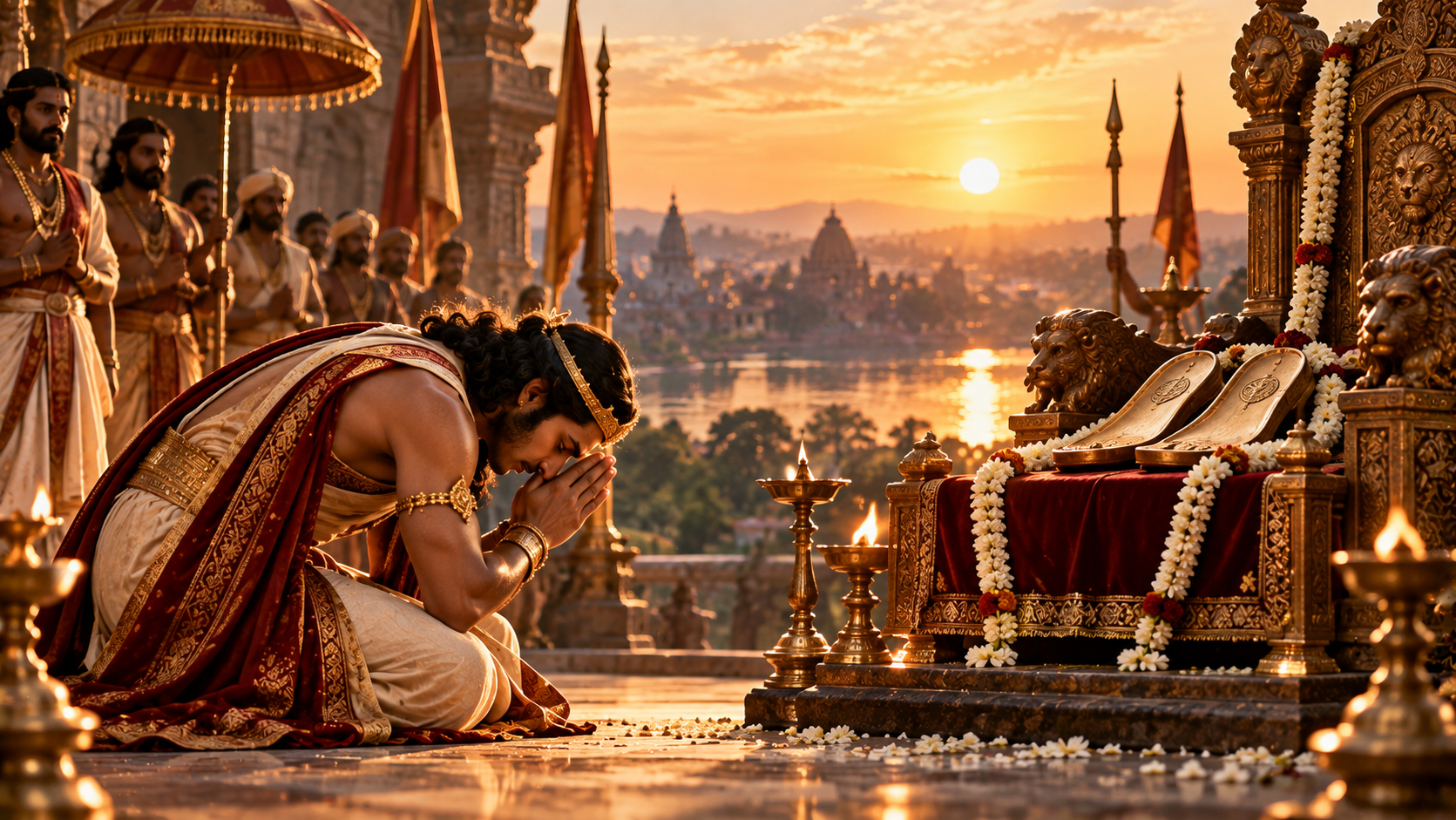
He left a city preparing a coronation. He came back to a funeral, an empty throne and a kingdom looking at him expectantly.
The story
Away when it happened
Bharata is away when it happens, in Kekaya, the land of his mother's family, far from Ayodhya. While he is gone, events at home move faster than any messenger: Rama, the eldest son and the newly named heir, is banished to the forest for fourteen years. King Dasharatha grants the exile under pressure from Kaikeyi — Bharata's own mother — who claims two boons the king once owed her. The first sends Rama away. The second places Bharata on the throne.
By the time he turns for home, his father is dead.
The return
He had left a city preparing a coronation. He returns to a city in mourning — grief for the king, grief for Rama, and beneath both something harder to read. Because the heir is coming home, and the heir is not Rama. Bharata rides through the gates to find the whole kingdom looking at him: the son who has just inherited everything.
Sit with his position for a moment. He has done nothing wrong. He was not there; he did not scheme; he cannot be blamed for a single decision made in his absence. And yet the prize is his, secured through his mother's demands, paid for with his brother's exile and his father's life. He did not create this advantage. He is standing in it.
Refusing the arrangement
His response is not gratitude, and the text does not soften it. He turns on Kaikeyi in terms that leave no ambiguity about what he thinks of what she has done.
But the refusal is the quieter part of the story. He does not tear the palace down; he does not perform his virtue for the court. He simply declines to sit. The throne the whole machinery of state has prepared for him stays empty, and Bharata starts planning a journey instead.
Into the forest
He gathers the elders, the ministers, the priests, the army and as many citizens as will come, and he goes to find Rama. This is not a delegation sent to formalise an apology. It is an attempt to reverse the thing entirely — to put the rightful heir back on the throne and the kingdom back into some kind of moral order.
The meeting between the brothers is the emotional centre of the episode. Bharata makes his case: come home, take what is yours, let me put this right. Rama holds his ground: their father gave his word, and a word given in weakness is still a word. The exile was granted; it must be completed. The two of them — each grieving the same father, each certain — argue not because either is foolish but because they are serving different duties. Rama's obligation runs to a promise. Bharata's runs to what is right. The epic respects both.
Neither yields. Which leaves the problem: the king is dead, the heir will not come home, and the kingdom cannot run on grief.
The sandals
The solution comes out of the impasse rather than ahead of it. If Rama will not return for fourteen years, and Bharata will not rule in his own name, then the throne needs a visible master who is not Bharata. Rama's sandals are taken from his feet. Bharata lifts them to his head — the gesture reserved for what one honours — and carries them back to Ayodhya.
He sets them on the throne. He rules in Rama's name, from a village outside the capital, and does not enter the city properly for the full fourteen years. Every decision of state is made as a custodian's decision, taken under a sign everyone can see.
Power is exercised; possession is refused. Both at once, in a single image. Ayodhya is governed for fourteen years under a pair of sandals.
Ownership and responsibility
It is worth being precise about what Bharata refuses, because it is not responsibility. He administers the kingdom, hears disputes, keeps the state intact and hands it back whole. What he refuses is ownership. He will carry the work of a king; he will not accept the claim of one.
That is the distinction the sandals hold in place. Authority exercised for someone else reads differently from authority exercised for yourself — and Bharata makes sure everyone can see the difference, daily, from a throne he will not touch. The legitimacy on display in Ayodhya belongs to an absent man in the forest. Bharata is simply careful not to obscure it.
There is a harder reading too. Rama keeps his word because a promise binds regardless of how it was extracted. Bharata refuses the gain because an advantage does not become clean by passing through your hands. Between them they cover the whole territory: what you owe, and what you will not take.
Why it matters
Dharma Pitch editorial reflection
The obvious question is what you would do with power you earned. Bharata's story asks the rarer one: what do you do with power you didn't — power that arrived through a wrong you had no part in?
His answer is exact. Refuse the ownership, keep the responsibility. Walking away would have been easier; keeping the throne would have been more natural. He does the harder third thing.
And he makes the refusal public. A private promise can be broken quietly. A pair of sandals on a throne cannot.
Source & Context
The episode belongs to the Ayodhya portion of the Ramayana and follows directly from Rama's exile and the king's death.
Valmiki's text and later retellings — regional literary Ramayanas, devotional works, theatre and television — weight the characters differently, and the tone of Bharata's confrontation with his mother varies considerably between them.
This retelling follows Valmiki's Ayodhya Kanda for Bharata's vow and the sandals episode, while recognising that later retellings shift emphasis and tone.
Sources checked
- Valmiki RamayanaAyodhya Kanda 2.112.23–25 and 2.113
An editorial retelling based on the Ayodhya section of the Ramayana. It paraphrases the narrative and quotes no verses. Emphasis and detail differ between Valmiki's text and later regional and devotional retellings.
What it raises
- 01
What do you do with an advantage created by a wrong you did not commit — especially when no one would blame you for keeping it?
- 02
Rama keeps a promise; Bharata refuses a gain. If you had to say which brother is right, what would you be weighing?
- 03
The sandals hold power only because everyone chooses to see it there. Can a symbol really restrain power, or does it only work on people already willing to be restrained?
Explore further
Dharma
Used here in at least two senses at once: keeping one's word, and the obligations attached to an office. The story is the friction between them.
Read the entryCompeting duties
The Mahabharata makes this its permanent subject; the Ramayana stages it sharply here.
Read the entryDecision-making
A contemporary framework for situations where the lawful option and the right option come apart.
Read the entry