
Story · Puranic tradition
A boy with a fixed lifespan, and the day it ran out
Markandeya was granted a short life of exceptional quality instead of a long ordinary one. The story of what happened at the end of it exists in more than one version.
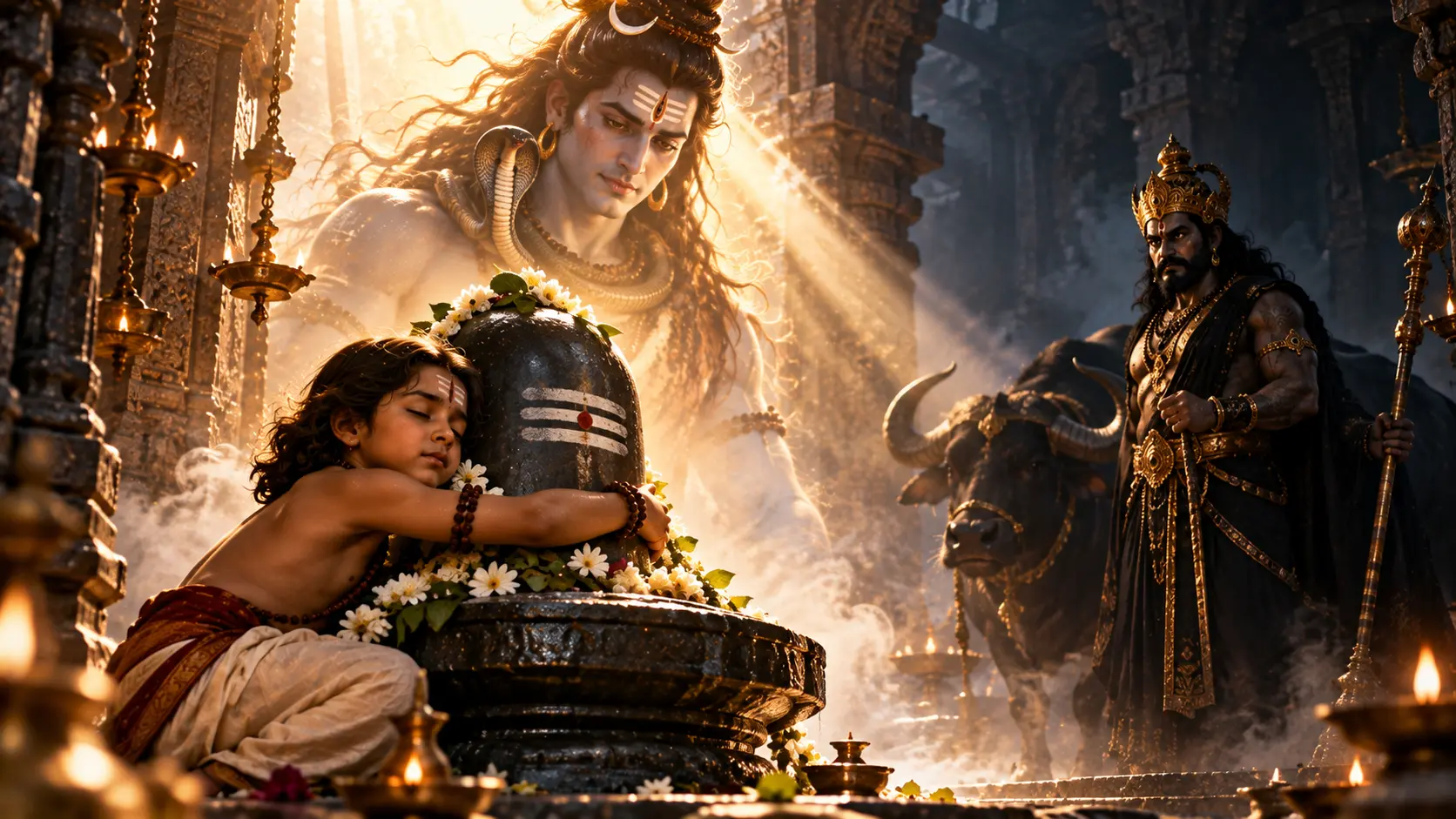
Before Markandeya was born, his parents were given a choice: a son who lived long and grey, or a son who burned bright and brief. What happened on the last day of the brief life is the story.
The story
The choice that came first
Every version of this story begins the same way: with parents who have no child, and have asked for one long enough that the asking has become its own kind of life. What they are finally granted is not a simple yes. It is terms.
They may have a son who is ordinary and long-lived. Or a son who is extraordinary in every way — and short-lived. No one tells them how to choose. The story does not tell them either. It records what they chose, the short life, and lets the silence around it do its work.
The boy is born, and he is everything they were promised. Quick, bright, unlike other children. And always, behind the celebrations, the clause.
A childhood with an end date
His parents keep the terms from him. They keep their grief behind closed doors too, but grief of that size does not stay behind doors. It shows in the conversations that stop when he walks in. In the way his mother watches him on ordinary afternoons as if memorising him. In his father's silences, which carry a different weight from other people's.
He is not a child who misses things. Sooner or later he learns the truth — the tellings differ on how, and it scarcely matters which is right. What matters is what he does next. He does not rage at his parents. He does not set about cramming a whole life into the years remaining, ticking off experiences like a list. He turns toward Shiva.
In the story's own grammar, this is not bargaining and it is not escape. It is orientation. A boy decides what his attention belongs to, and then gives it, day after day, with the deadline standing in plain sight. However many birthdays remain, this is what he does with them.
The day Death kept the appointment
The final day arrives the way final days do: as a day, with weather in it. The tellings agree on the shape of what follows even where they differ on the details. The boy goes to worship. He stands before the linga — the simple stone form in which Shiva is met — and he holds on to it.
Yama comes. In this tradition Death carries a noose, and the noose is thrown. What the story fixes in the memory is what the boy does: he does not run, and he does not plead. He holds on. A noose and a boy's grip, and between them, the whole question.
What happens next is where the versions part company, and the differences are laid out below rather than smoothed over here. What they share is the outcome. Shiva intervenes, and the intervention is decisive. In the telling most people know, he does not send a messenger or a word; he bursts from the linga itself and stands between Death and the child, and Death does not take the boy. In some accounts Death is struck down for overstepping. In others he is rebuked and sent away. And in several, the boy is not merely reprieved — he is let go from death altogether, the child who was to die young becoming the sage who outlives everything.
What the miracle is not
Read as a transaction, the story collapses: a boy prays, death loses, therefore pray. But no one who retells this story lives that way — including the parents who wept for him. Everyone in the story dies except the boy. Everyone hearing it dies too.
So the miracle is not a rule. It may not even be the point. The point is what the boy did with the years he knew he had. He did not spend them running from death, and he did not spend them waiting for it. He chose, early, what his life would be about — and then he lived that choice all the way to the appointed day.
Whether the appointed day turned out to be the end is the tradition's claim to make, not ours. What survives the miracle is a plainer thing and a harder one: a portrait of a person who knew exactly how much time he had, and gave it to something he believed was larger.
Why it matters
Dharma Pitch editorial reflection
Mortality is usually abstract — a fact about later. This story makes it a date, and then asks what a person does with the days between now and it.
Markandeya's answer is not to run and not to hide. He gives his attention to what he believes is larger than his death, and lets the deadline stand where it is.
Everyone who tells this story dies. The story knows that, and tells itself anyway. What it offers is not more time. It is a question about what your time is for.
Source & Context
The narrative has Puranic references and strong Shaiva devotional, temple and iconographic traditions. It is not drawn from one universally authoritative account, and versions differ on substantive points — including which parents, the exact terms of the choice, the boy's age, and what precisely happens when Yama arrives.
The age of sixteen is the figure most often repeated, but it is not fixed across sources, so the story above leaves his lifespan as youth cut short. The image of Shiva bursting from the linga to stand between Yama and the boy, and the accounts of Yama being struck down or subdued, belong to the later devotional and temple traditions; their exact textual basis has not yet been verified.
Later traditions honour Shiva as Mrityunjaya — the conqueror of death — and connect Markandeya with that devotion. The title describes Shiva in those traditions; it is not presented there as a promise transferred to whoever prays. The Vedic Tryambakam mantra is a much older, distinct thread and should not be folded into this narrative.
No verses, chapters or specific Puranic citations are given here. Exact mapping of each variant remains editorial work.
An editorial account of a narrative that exists in multiple differing versions across Puranic and later Shaiva sources. No single text is presented as canonical, no verses are quoted, and no chapter or verse citations are given. The story text narrates only the outline the traditions share; the Shiva-from-the-linga episode, the fate of Yama and the age-sixteen figure are treated as widely told but textually unverified and are flagged as variants. Source attributions are pending editorial verification.
What it raises
- 01
If you knew your date, what would you stop doing tonight?
- 02
Markandeya does not spend his last years running from death. What would you give your attention to if you could not pretend time was unlimited?
- 03
The story spares the boy. It spares no one who tells it. So what is it actually offering?
Explore further
Death and what remains
The question the Katha Upanishad puts to Yama directly, approached here from a different tradition and a different mood.
Read the entryDevotion and practice
In most versions what saves Markandeya is his practice and the relationship it establishes, rather than an argument.
Entry in preparationAtman
Traditions differ sharply on what, if anything, persists through death. This narrative does not settle the question and neither do we.
Read the entry