Story · Upanishads
The Boy Who Went Looking for Death
Nachiketa asked a question that even the gods had struggled to answer. Death offered him almost everything to stop asking.
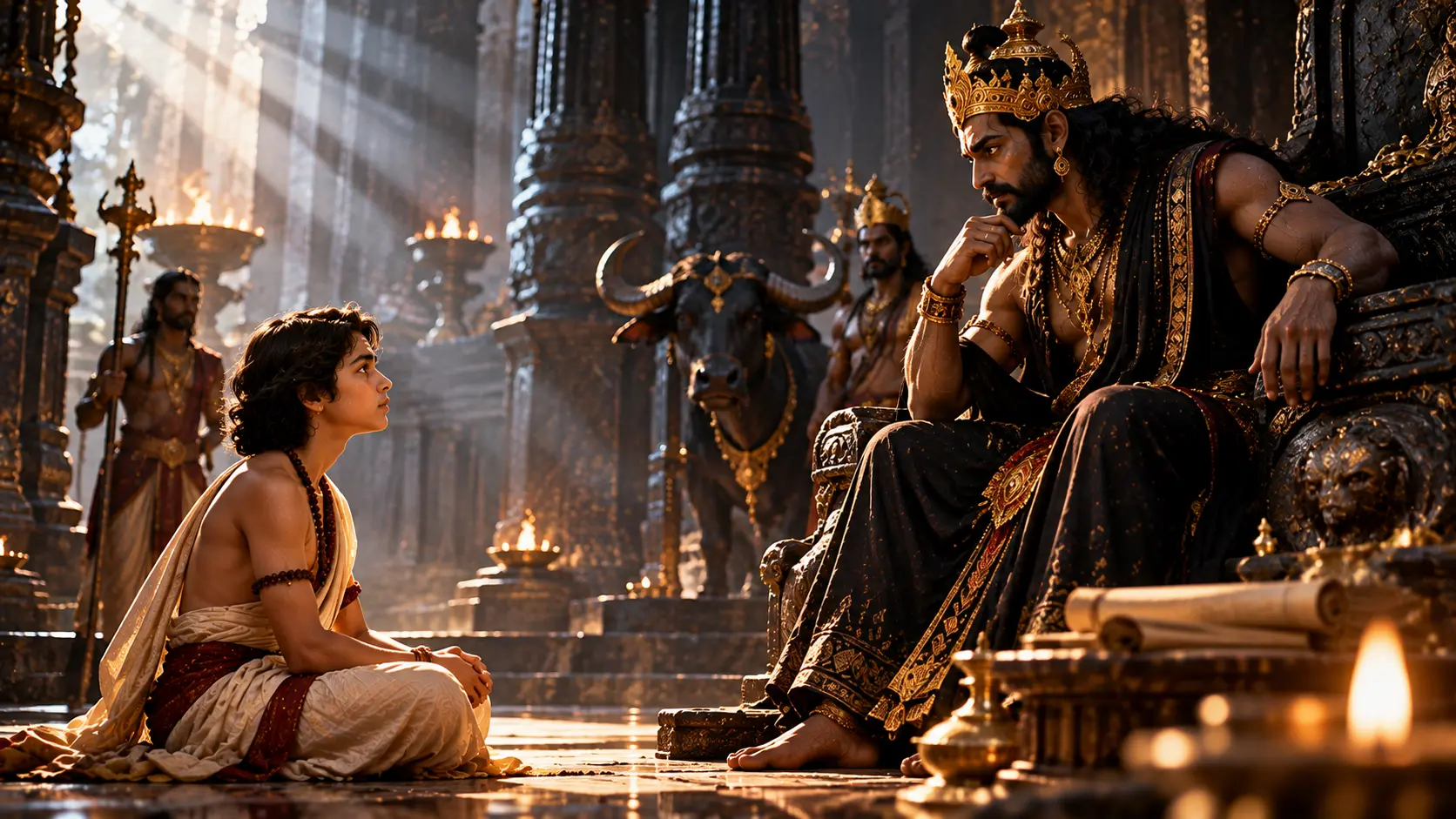
A child travelled to the house of Death, waited three nights at his door, and would not leave without an answer.
The story
A question at a sacrifice
Thousands of years ago, a young boy named Nachiketa watched his father perform a great sacrifice. It was meant to be an act of giving. Cows were being donated, possessions were being given away, and it was the kind of act that was supposed to show generosity and devotion.
But Nachiketa noticed something. The cows being given away were old. They had eaten their last grass, drunk their last water and given their last milk. They had almost nothing left to give. And the boy began to wonder: if you give away something that has no value left to you, is that really giving?
It was a simple question. But simple questions can be uncomfortable when everyone else has decided not to ask them.
Nachiketa watched his father continue with the sacrifice and then went to him. “Father, to whom will you give me?” His father ignored him. Nachiketa asked again. Still no answer. So the boy asked a third time.
This time, his father lost his temper. “I give you to Death.”
Perhaps he said it only in anger. Perhaps he expected the words to disappear as quickly as they had been spoken. But Nachiketa took them seriously.
And so a young boy set out to meet Death.
Three nights waiting for Death
Nachiketa eventually arrived at the home of Yama, the Lord of Death. But Yama wasn't there. There was no one to receive him, no food and no welcome. So Nachiketa waited.
One night passed. Then another. Then a third.
Imagine that for a moment. A child has travelled to the house of Death. Death isn't home. And instead of running away, the child waits at his door for three nights.
When Yama finally returned, he discovered that a young guest had been left waiting without food or hospitality. This was no small matter. A guest was meant to be received with respect, and this guest had been neglected for three nights. To make amends, Yama offered Nachiketa three boons — one for each night he had waited.
Nachiketa could ask for three things.
His first wish was not for wealth or power. It was for his father. He asked that his father's anger disappear, that he recognise him when he returned, and that there be peace between them again.
Yama granted it.
For his second boon, Nachiketa asked to understand the sacred fire associated with reaching heaven. Yama taught him.
Two wishes were complete. One remained.
And this time, Nachiketa asked the question that had brought him face to face with Death.
The question Yama did not want to answer
What happens when a person dies?
Some say something remains. Others say nothing remains. Which is true?
You might expect the Lord of Death to have an answer ready. Instead, Yama tried to avoid the question. It was too difficult, he told the boy. Even the gods had wondered about it. Ask me something else. Anything else.
But Nachiketa would not change his question.
So Yama tried something different. He offered him a deal. Choose sons and grandsons who will live for generations. Choose cattle, elephants, horses and gold. Choose a vast kingdom. Choose a life as long as you desire. Then Yama went further and offered pleasures beyond anything an ordinary human being could hope to possess.
Take all of it, he told him. Just don't ask me about death.
For most of us, the conversation might have ended there. For Nachiketa, it didn't.
He understood something. Everything Yama was offering him had one thing in common: it would end. Wealth could disappear. Pleasure would pass. The body would grow old. Even the longest life would eventually arrive at the very question Nachiketa was asking now.
So the boy refused.
Keep the wealth. Keep the pleasures. Keep the long life.
Tell me the truth.
And that was when Yama finally began to teach him.
The pleasant and the good
Yama began with a distinction that sounds simple, but may be one of the hardest distinctions we make in life. There is what is pleasant, and there is what is good. The Katha Upanishad calls them Preyas and Shreyas.
Sometimes the pleasant thing and the good thing are the same. Sometimes they are not. And when they are not, we have a choice to make.
The pleasant often gives us something now: comfort, approval, ease or pleasure. The good may ask more of us: patience, discipline, courage, or the ability to walk away from something attractive because we understand where it eventually leads.
Nachiketa had just been tested with exactly that choice. Yama had offered him almost everything that was pleasant. Nachiketa chose to know what was true.
But Yama's teaching went deeper, because Nachiketa's original question was still waiting.
What actually dies?
What changes — and what remains
Our bodies change throughout our lives. So do our thoughts, emotions, desires and circumstances. The child becomes an adult. The adult grows old. Everything we can see seems to be moving, changing and eventually disappearing.
But the Upanishad asks us to look deeper. Is there something beneath all that change?
Yama teaches Nachiketa about the Atman — the deepest Self. Not personality. Not status. Not possessions. Not even the body.
The teaching of the Katha Upanishad is that this Self is not born when the body is born, and does not die when the body dies. It cannot be understood simply by collecting more information. It has to be known differently.
And then Yama gives the boy an image that has travelled across thousands of years.
A chariot.
The chariot
Imagine your life as a chariot. The body is the chariot and the senses are the horses. They are constantly pulling towards something — something to see, something to taste, something to hear, something to possess.
The mind holds the reins. But reins alone cannot decide where the journey should go. The intellect — buddhi — is the charioteer. It must know where to go. It must be able to guide the horses rather than simply being dragged wherever they want to run.
And the deepest Self — the Atman — is the one travelling in the chariot.
Suddenly, Yama's earlier teaching about the pleasant and the good becomes much more practical. The problem is not that the horses are bad. We need them. The problem begins when they decide the direction of the journey.
And then Nachiketa went home
The boy had received his three boons. He had asked his questions. And he had listened to Death speak about life.
Then Nachiketa returned to his father.
The child who had walked towards Death came home with a different understanding of what it meant to live. And perhaps that is why his story has survived for thousands of years.
Because Nachiketa's question was never only, what happens when we die?
Hidden inside it was another question: knowing that our lives will end, how should we live while we are here?
Why it matters
Dharma Pitch editorial reflection
Yama's answer does not give us a neat rulebook. Instead, it gives us something more demanding. Pay attention to what is pulling your chariot. Learn to distinguish what feels good now from what is genuinely good for you. And understand that the things you can possess are not necessarily the things that define you.
Thousands of years later, we may not be offered horses, cattle and kingdoms. Our temptations look different: money, status, attention, comfort, the approval of other people, the easier decision.
But the choice Yama placed before Nachiketa hasn't disappeared.
When the pleasant and the right are not the same, what will you choose?
Source & Context
Nachiketa's story comes from the Katha Upanishad, also known as the Kathaka Upanishad, associated with the Krishna Yajur Veda.
The story begins with Nachiketa, his father's sacrifice, his journey to Yama and the three boons. Their conversation then develops into a much deeper philosophical enquiry into death, the Self, knowledge and liberation.
The distinction between Shreyas (the good) and Preyas (the pleasant), and the famous chariot analogy, are part of Yama's teaching in the Katha Upanishad.
This Dharma Pitch version is a contemporary retelling rather than a literal translation. Some philosophical concepts — particularly Atman — have been interpreted differently across Indian philosophical traditions, so the simple language here should not be treated as settling those larger debates.
Sources checked
- Katha Upanishad1.1–1.2
This piece is an editorial retelling based on the Katha Upanishad. It paraphrases the narrative in contemporary English and is not a substitute for the original text or for a scholarly translation. No verses are quoted here.
What it raises
- 01
What is the standing of a question asked by someone with no authority to ask it?
- 02
Nachiketa spends his first boon on reconciliation with the father who sent him away. What does that choice say about how the story ranks its goods?
- 03
Why does the text have Death himself argue against answering — and what is gained by making the answer hard to obtain?
- 04
If the good and the pleasant arrive together and look alike, what would it take to tell them apart in an ordinary day?
Explore further
Atman
The Self, as the Katha develops it after the third boon. How it is understood — and its relation to the wider whole — differs sharply between later schools.
Entry in preparationShreyas and Preyas
The distinction the text draws between what is genuinely good and what is merely pleasant. Both are said to approach a person; the choice between them is the text's concern.
Entry in preparationDharma
What upholds a person and their relationships. Read alongside this story, questions of hospitality, a father's word and a son's obligation are all in play.
Read the entryMoksha
Release or liberation — the horizon towards which enquiry into death and the Self is often pointed, though not every tradition frames it identically.
Entry in preparation