
Story · Upanishads
Asked who his father was, the boy said he did not know
A boy who wants to study cannot answer the first question a teacher asks him. His mother gives him an answer with no status and no cover in it — only the truth — and that answer is why the story survived.
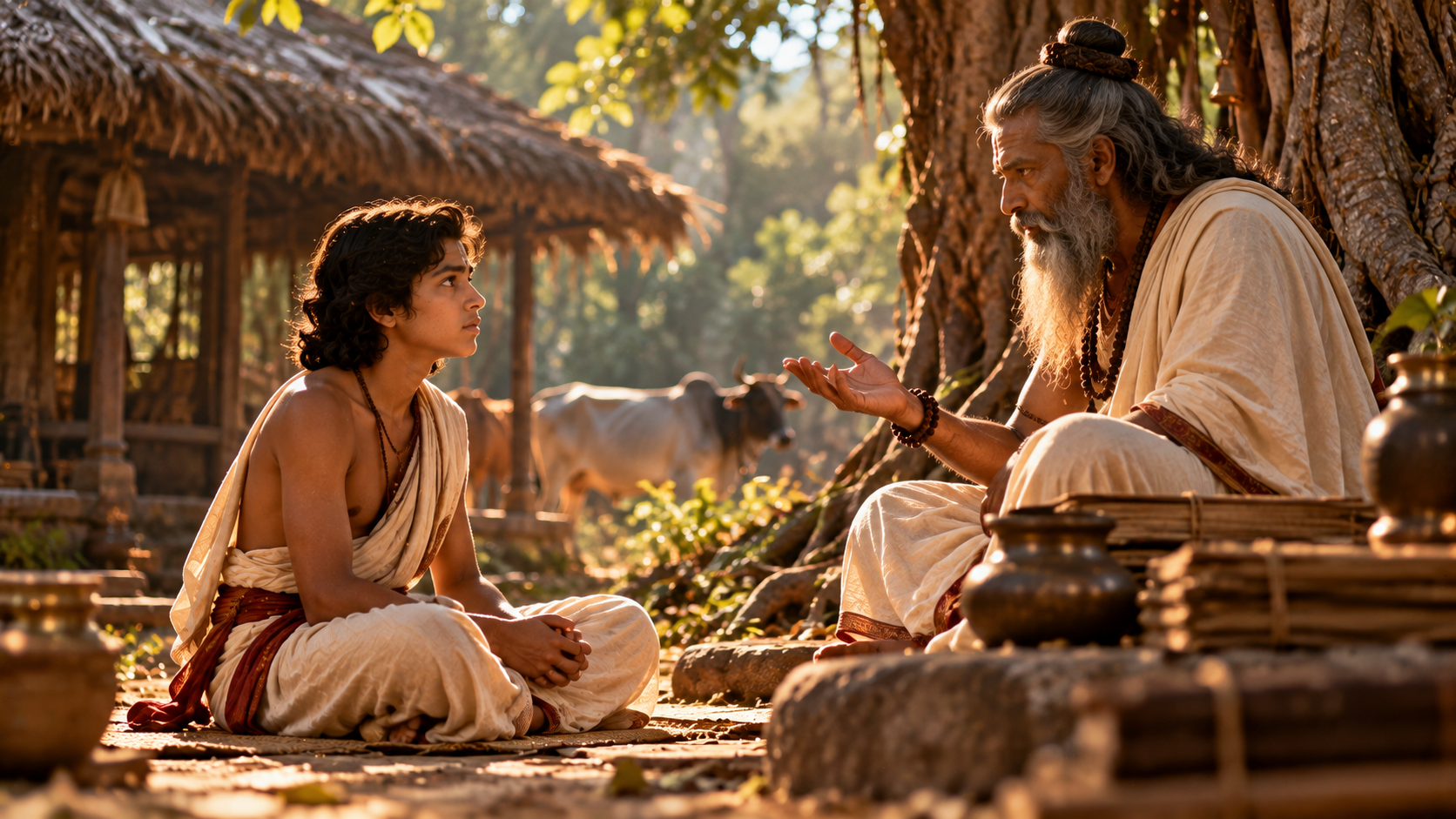
He went home and asked his mother who his father was. She could not tell him. She gave him the truth instead, and the truth was enough.
The story
A boy who wanted to learn
Satyakama is a boy who wants to study. In his world, learning is not something you sign up for. You attach yourself to a teacher, you live in or near his household, you serve and you listen, and over years you are taught. The first step is admission — and admission begins with a question: who are you? Whose son are you? What family line do you come from?
It is not small talk. In that world, a student's lineage tells a teacher where he has come from and what carries through him. A teacher asks it the way a gate is asked. And Satyakama cannot answer it.
So he does what a child does with a question too big for him. He takes it home to his mother.
Jabala's answer
Her name is Jabala, and she does not dress anything up. She tells him that when she was young she moved about a great deal — serving in many places, in many households — and that he was born in those years. She does not know whose son he is.
Then she gives him what she has. She knows her own name, and she knows his. So: call yourself Satyakama, son of Jabala. If the teacher asks, say exactly that.
Look at what the answer contains. No apology. No story that softens the edges. No instruction to shade anything, or leave anything out. Her son is about to walk into a world that will weigh him by his origins, and his mother hands him the one thing she holds with certainty — her name — and lets him carry it as it is. It is the least respectable answer available to her, and she gives it without flinching.
The answer that cost something
Satyakama goes back to the teacher, Haridrumata Gautama, and gives his mother's answer exactly as she gave it. He names himself. He says what his mother said. Where a father's name would go, he leaves the space empty rather than fill it.
It is worth pausing on what he did not do. He could have invented an ancestor. The teacher had no easy way to check. Nobody standing there would have known. A single smooth lie would have opened the gate and cost him nothing that day. The whole weight of the story rests on the fact that he leaves the space empty.
Gautama's response comes, and translations render it with different force. Some have the teacher say that nobody but a brahmana could have spoken like this. Others keep it plainer: the boy has not departed from the truth. However it is worded, the hinge is the same. The teacher takes the truthfulness itself as the evidence — the sign of the kind of student he is being asked to accept — and he admits him.
There is something quietly radical in how the teacher reads the answer. Satyakama has offered him the least impressive version of himself, and Gautama treats that as the qualification. A student who will not lie about where he came from is a student who will not lie about what he has understood, or what he has not. For a teacher, that may be the only fact about a pupil that matters.
Out with the cattle
Admission, it turns out, does not look like sitting at a teacher's feet. Gautama sends him away with cattle and tells him to return only when the herd has grown to a size he did not choose. Years go by.
In the story, what he learns in those years comes to him in stages, through beings encountered along the way, and the Upanishad uses that long stretch of solitude to open out its teaching about the vastness of what is being studied. The details belong to a later part of the episode; what matters here is the shape of it. Even the boy whose truthfulness opened the gate is not handed knowledge. He is sent out with it, into years of attention.
When he finally returns, the teacher recognises something in him before he says a word — the look, the story says, of someone who has been taught. Whether that means the years themselves, or the company he kept out there, the text leaves open.
Why it matters
Dharma Pitch editorial reflection
Most of us will never be asked a question as bare as the one Jabala answered. But we all meet versions of it — moments when the honest answer makes us look less secure, less impressive, or less conventional than we would like.
Satyakama could not improve the facts of his life. So he refused to improve the story. And the teacher heard the refusal as the strongest thing in the room.
His mother gave him the only thing she had that was certain: her name. It turned out to be enough to build an identity on.
Source & Context
The episode belongs to the Chandogya Upanishad, associated with the Sama Veda and among the longer and older of the Upanishads. The admission scene sits in the fourth chapter.
It is a teaching text organised around dialogues, and the Satyakama narrative functions as a frame for instruction rather than as biography.
The teacher's remark is rendered differently across translations — some making it a claim about brahmana identity, others reading it simply as recognition of truthfulness. How far the episode can be read as a statement about social structure is debated, and this retelling quotes none of it.
Sources checked
- Chandogya Upanishad4.4.1–5
An editorial retelling checked against Chandogya Upanishad 4.4.1–5. It paraphrases in contemporary English and quotes no verses. Translations differ in emphasis, particularly in the teacher's response.
What it raises
- 01
Jabala's answer gave her son no status and no cover. Would you have given it — or softened it first?
- 02
Gautama weighed a claim about lineage against a boy's refusal to invent one. Which of those two things should open a gate?
- 03
Where in your own life is an honest answer waiting that would make you look smaller — and what is the cost of never saying it?
Explore further
Knowledge and qualification
Who is permitted to learn, and on what basis, is a live question across this literature and not settled the same way in every text.
Read the entryAtman
The Chandogya develops some of the best-known teaching on the Self. The Satyakama narrative is part of its approach to that material.
Read the entryDharma
Truthfulness is one of the qualities repeatedly gathered under the word. Here it is treated as a competence, not just a virtue.
Read the entry