
Story · Upanishads
She kept asking what everything rests on until she was told to stop
Gargi Vachaknavi questions Yajnavalkya in front of a full assembly, and the exchange ends with one of the sharpest warnings in the Upanishads.
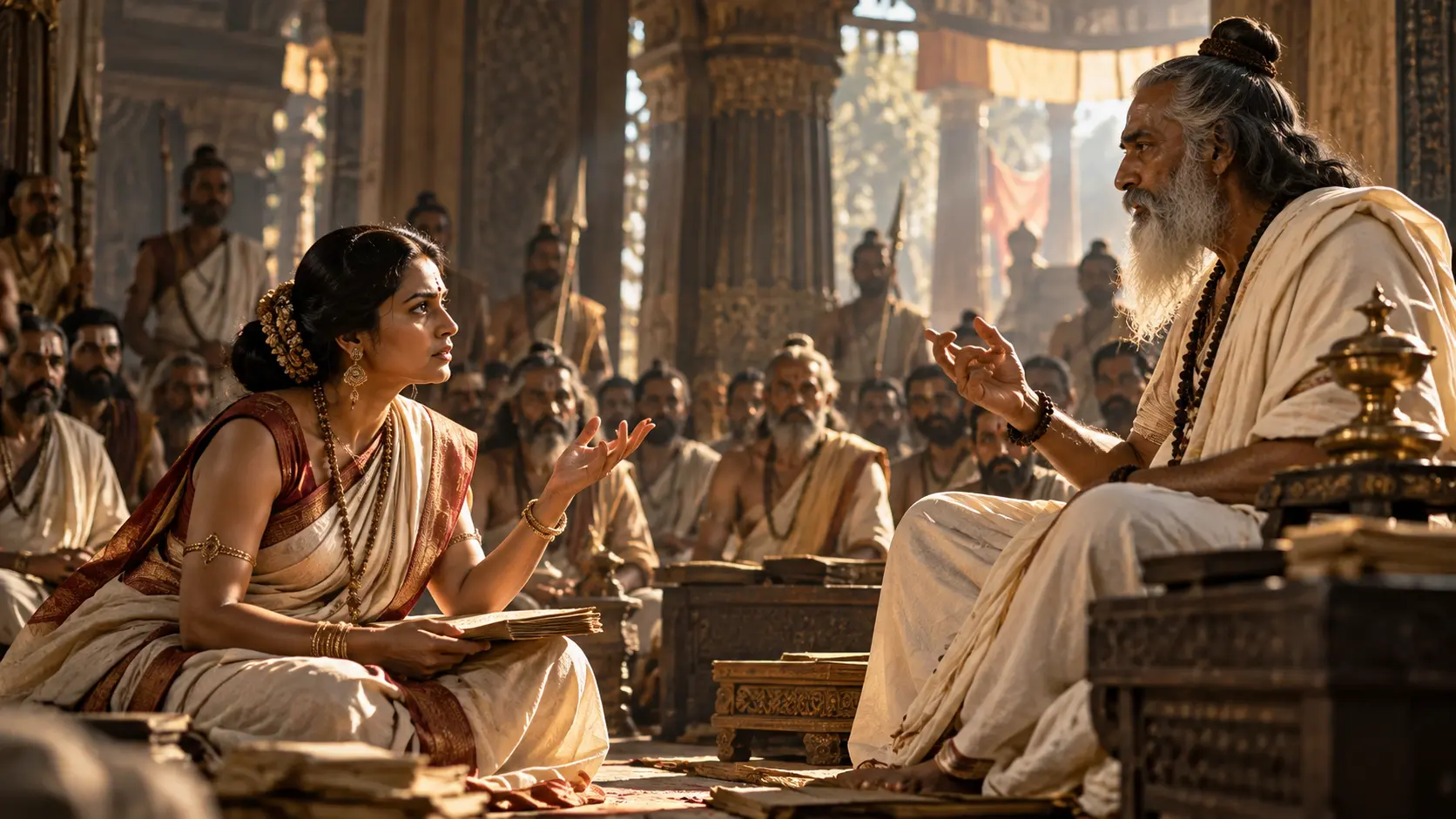
Her method was simple and relentless: whatever he named, she asked what that was woven upon.
The story
A room full of challengers
King Janaka of Videha holds a great sacrifice, and the learned of the land have gathered for it. At some point the gathering turns into a contest. Yajnavalkya, the most confident mind in the room, effectively claims the prize for himself — the tradition gives him a herd of cattle and an announcement that he is the most learned among them. The others are invited to prove otherwise. Anyone may stand and question him.
It is that kind of room. Public, competitive, exacting. These are not conversations for comfort; they are examinations conducted in front of witnesses, where a man's standing can rise or fall on a single answer. Several questioners take their turn. Some press Yajnavalkya hard, and he answers them all.
Then Gargi Vachaknavi stands. The text introduces her as one of the questioners, nothing more — no biography, no lineage, no special pleading. What we know of her is what she does next, and it is enough.
What is that woven upon?
Her method is a regress, and she works it without hesitation. Whatever Yajnavalkya names, she asks what it is woven upon — what it rests across, the way cloth rests on its threads. He answers; she takes his answer as the new question. The chain moves steadily outward: from the world we stand on, through the worlds beyond it, toward whatever encompasses all of them. Each of his answers becomes, for her, simply the next thing that must rest on something.
This is not a trick. It is a serious instrument of enquiry, and Yajnavalkya treats it seriously, answering each turn. But a regress like this cannot run forever. Eventually it reaches something that cannot be referred to anything further — and Gargi presses past it anyway.
At that point Yajnavalkya stops her. He tells her not to question beyond this, with a warning about what happens to one who does — a line that translations render with very different force, from a formal boundary of the debate to a severe caution about her head. Whatever its precise weight, the exchange closes. Gargi falls silent. But the silence is not the end of her part in this contest, and it is worth noticing what kind of silence it is.
She comes back with two arrows
Later in the same contest, after others have had their turn, Gargi rises again. She does not pick up the stopped thread. She announces to the whole assembly that she will put two questions to Yajnavalkya, and she describes them as arrows — if he answers both, none among them will defeat him.
Her two questions do not repeat the old regress. They approach from a new angle, asking what the whole of this — everything above, below and between — is woven upon. This time Yajnavalkya develops the answer at length, and it arrives at the famous characterisation of the imperishable: described not by what it is but by what it is not. Not coarse, not fine, not short, not long — a reality that the ordinary machinery of description cannot grip, only point toward.
Gargi turns back to the assembly and tells them plainly that none of them will defeat this man. She concedes — and the concession is hers to give, from a position no one in that room could mistake for weakness.
Knowing when the question must change
What stays with you about Gargi is not only that she asked. It is that she stopped, thought, and returned with a better question. The first exchange ended at a boundary; the second found a way around it, not by defying the limit but by reformulating the enquiry so it could carry more.
Yajnavalkya, for his part, is no villain and no comfortable guru. He is brilliant, combative and difficult, and the electricity of the episode comes from the fact that both of them are. Intellectual courage is not simply asking more questions. It is recognising when a question has hit the limit of its current form — and doing the harder work of finding the question that comes after.
Why it matters
Dharma Pitch editorial reflection
Serious enquiry asks two things of everyone present: courage from the questioner, and enough confidence from the room to let the question stand. Janaka's assembly had both, and this exchange is the proof.
Gargi's real strength was not persistence alone. It was the ability to stop at a genuine limit, return, and ask again in a form the limit could not block. Most of us only ever learn the first half.
Source & Context
The exchanges are in the Brihadaranyaka Upanishad, associated with the Shukla Yajur Veda, within the sequence of debates at Janaka's court. Gargi questions Yajnavalkya twice — at 3.6 and again at 3.8 — and this account keeps the two rounds distinct, as the text does.
Reading the episode alone distorts it; it is part of a longer contest with several questioners, and its force depends on that setting.
The precise sense of Yajnavalkya's warning to Gargi at 3.6 is genuinely contested among translators and commentators — rendered variously as a ritual boundary, a methodological limit or a severe threat. This retelling reports that disagreement rather than resolving it.
Nothing here is a quotation. The questioning, the archer image, the negative characterisation of the imperishable and Gargi's concession are paraphrased from the Sanskrit text in standard translation.
Sources checked
- Brihadaranyaka Upanishad3.6 and 3.8
An editorial account checked against the Gargi–Yajnavalkya exchanges at Brihadaranyaka Upanishad 3.6 and 3.8. Nothing is quoted. The sense of Yajnavalkya's warning is contested between translators, and this piece deliberately leaves it open.
What it raises
- 01
When you are told a question has gone too far, how do you tell the difference between a genuine limit and a door someone does not want opened?
- 02
Have you ever stopped asking — and later found the better question you should have asked instead?
- 03
What kind of room makes real questioning possible, and what kind only rewards the questions it already likes?
Explore further
Atman
The Brihadaranyaka is one of the central sources for teaching on the Self, including the negative method used in this exchange.
Read the entryKnowledge and enquiry
The Upanishads frequently proceed by questioning rather than assertion. This is that method at full extension.
Read the entryMoksha
Where enquiry of this kind is often said to lead, though traditions differ substantially on what that means.
Read the entry