
Story · Mahabharata
The Man Who Turned Down Heaven
A messenger arrived with an extraordinary invitation. Mudgala had earned a place in heaven. The celestial vehicle was waiting. Most people would have asked: When do we leave? Mudgala asked something else. What are the disadvantages of heaven?
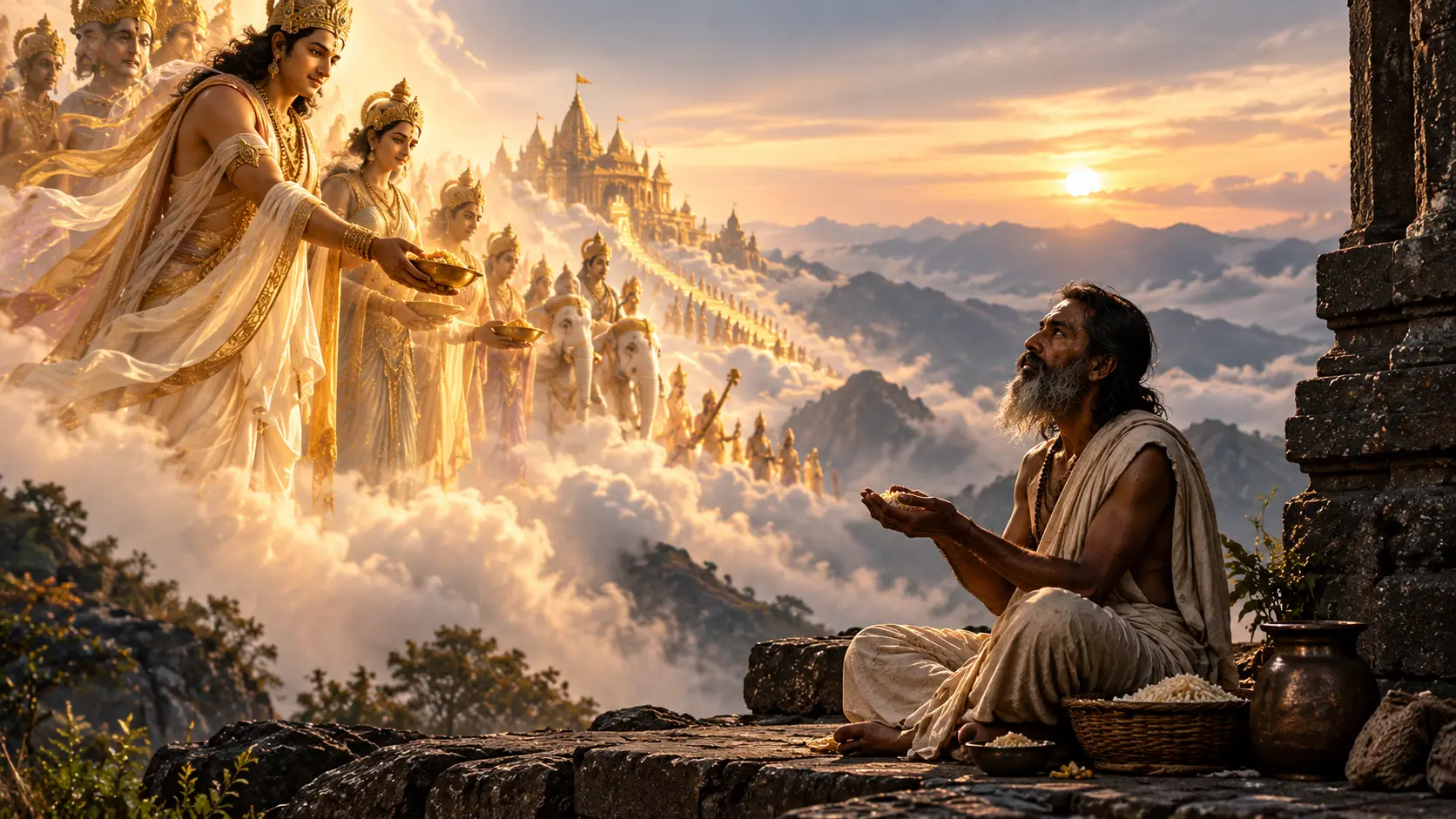
Mudgala had been tested by hunger and remained generous. His harder test began when everything he had earned arrived at once.
The story
A life built from what others left behind
The Mahabharata places Mudgala in Kurukshetra, living by gathering grains left in the fields after the harvest. The text describes an austere discipline: he and his household lived with very little, performed their rites and fed guests before eating what remained.
This was not generosity made easy by abundance. The food had been collected slowly, grain by grain. Giving it away could mean waiting for the next meal. Yet hospitality remained part of the life Mudgala had chosen, not a virtue reserved for moments when he had enough to spare.
Then Durvasa came to test him. In this episode, he arrives repeatedly as a demanding guest. He consumes what is offered and leaves Mudgala and his family without their expected food. The traditional English rendering describes the test happening six times. Each time, Mudgala begins again. The text presents him as remaining free of anger, resentment and agitation.
Durvasa's wider reputation for fierce anger belongs to a much larger body of epic and later storytelling. Here, the important point is narrower: he tests whether Mudgala's generosity survives inconvenience, hunger and repetition. It does.
The invitation
After the test, Durvasa praises Mudgala's restraint and generosity. Then a celestial messenger appears with a vehicle and an invitation. Mudgala's conduct, he is told, has earned him heaven.
The offer is not presented as a trap. The messenger describes heavenly existence in glowing terms: a realm reached through meritorious action, free from many ordinary forms of suffering and filled with extraordinary pleasures. Svarga is a genuine reward within the moral world of the episode.
Mudgala does not dismiss it. Nor does he climb aboard. Before deciding, he asks the messenger to explain the whole destination — its benefits and its limitations.
That question changes the story. Mudgala is not being asked to resist something obviously corrupt or harmful. He is being offered the result of his own virtue. The chariot is there because he has lived well. Yet even at the moment of reward, he wants to know where the reward ultimately leads.
The part left out of the invitation
The messenger answers at length. Heaven brings happiness, honour and experiences unavailable in ordinary human life. But its pleasures are linked to accumulated merit. While that merit lasts, the heavenly state lasts. When it is exhausted, return and loss follow.
The Mahabharata does not therefore say that heaven is simply bad. Its argument is more exacting. A condition can be wonderful and still be conditioned. A reward can be deserved and still be temporary. Pleasure does not become false because it ends, but its ending matters if someone has mistaken it for a final destination.
Mudgala listens to both sides. Then he refuses the journey. The episode turns towards his search for a state not subject to the same cycle of attainment and loss — towards contemplation, knowledge and liberation rather than a celestial reward whose duration depends on merit.
That movement needs care in contemporary language. Svarga and moksha are not synonyms. In many Hindu philosophical accounts, svarga is a desirable but temporary result within conditioned existence; moksha names release from that condition. Traditions disagree about what liberation is and how it is reached. The episode gives one narrative expression of the distinction; it does not settle every Indian school's account of the afterlife or freedom.
Questioning success
It is easy to admire discernment when it rejects something clearly destructive. Mudgala's choice is more unsettling because the offer is magnificent. He has not cheated to obtain it. He has not pursued it through cruelty. Heaven arrives as the consequence of discipline, hospitality and restraint.
His question is not whether the reward is impressive. It is whether the reward is enough.
That distinction reaches beyond the cosmology of the story. Much of modern life is organised around arrivals: the qualification, the role, the recognition, the security, the audience, the house. These things can be valuable. Mudgala's story does not require us to despise them. It asks whether we have examined what comes after them — and whether a goal that ends can bear the weight of being treated as the purpose of a life.
The courage in the episode lies not only in refusing. It lies in asking for the disadvantages before desire has made the decision. Mudgala wants the full account, even when a partial account would be far more pleasant to hear.
Why it matters
Dharma Pitch editorial reflection
Mudgala's refusal is not a rejection of pleasure, ambition or earned reward. It is an act of discrimination between a valuable experience and a lasting freedom.
The story asks whether success can be examined with the same honesty as failure. A dazzling destination may still be one stage in a longer journey.
Source & Context
The primary basis is the Mudgala episode in the Mahabharata's Vana Parva. In Kisari Mohan Ganguli's English translation, Sections CCLVIII–CCLIX describe Mudgala's gleaning life, hospitality, Durvasa's repeated test, the celestial messenger, the merits and limitations of heaven, and Mudgala's refusal. Chapter and section numbering varies across editions and recensions, so the episode and edition are named rather than presented as universal numbering.
The source presents heaven as a real reward of meritorious action and also says that its enjoyment ends when merit is exhausted. Mudgala then seeks a state without those defects. The language here about achievement, success and destinations is Dharma Pitch editorial reflection, not dialogue from the Mahabharata.
Durvasa's broader reputation comes from epic and later narrative traditions. This retelling uses only his role in the Mudgala episode and does not merge it with other Durvasa stories.
The distinction between temporary heavenly reward and liberation appears in different forms across Indian traditions. This article follows the logic of this episode without claiming that every school defines svarga, moksha or the path beyond conditioned existence identically.
Sources checked
Checked against the Mudgala episode in the Vana Parva using the named Ganguli translation. The narrative is paraphrased without invented dialogue; the source account, broader tradition and Dharma Pitch reflection are kept distinct.
One question to carry with you
- 01
If everything you are currently working towards arrived tomorrow, where would it lead you next?