
Story · Mahabharata
The Ascetic Who Thought He Had Mastered Dharma — Until He Met a Shopkeeper
Jajali's austerities were so severe that birds nested in his hair. Then an unexpected voice sent the accomplished ascetic to learn about dharma from a merchant named Tuladhara.
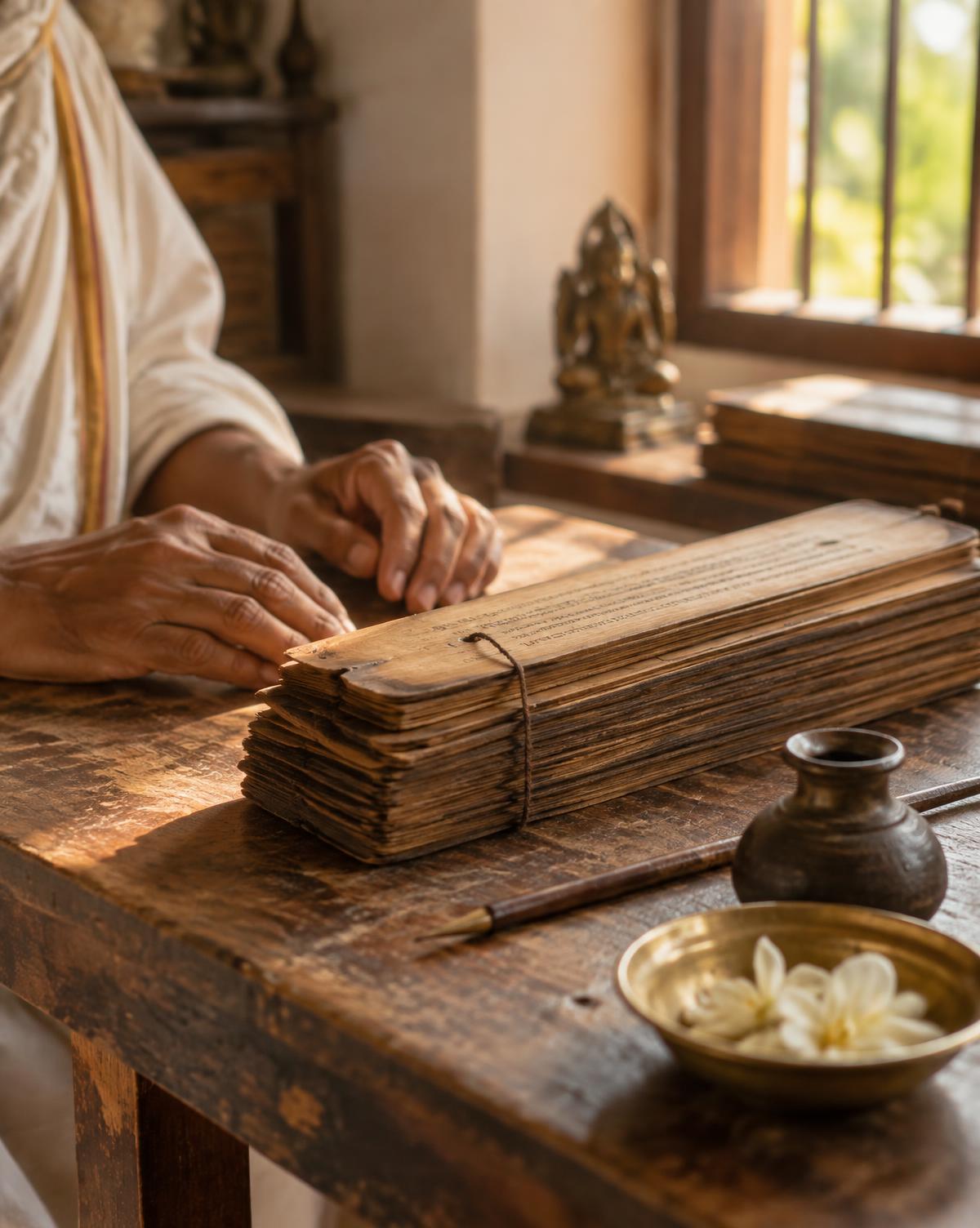
Jajali had performed austerities so severe that birds built a nest in his hair.
The story
The nest
Jajali had performed austerities so severe that birds built a nest in his hair. He stood so still, for so long, that the birds came, laid their eggs, and raised their young on his head.
He did not disturb them. The eggs hatched. The chicks grew. One day they flew away — and Jajali stood there, unmoved, regarding himself with quiet satisfaction.
That satisfaction was the beginning of his trouble.
The voice
Pride, the story says, entered him — the belief that he had mastered dharma, that there was nothing left to learn. A voice then spoke to him, telling him plainly that his pride had unmade what his discipline had built, and directing him to someone he would never have chosen as a teacher: a merchant named Tuladhara.
His name evokes the balance or weighing scale — fittingly, for a merchant.
The shopkeeper
Tuladhara was not in a hermitage. He was in the marketplace, among scales and goods and customers, living an ordinary commercial life.
And from this most unpromising of teachers, Jajali received one of the Mahabharata's most searching accounts of dharma: that right conduct is not the property of ascetics alone; that non-injury, honesty and fairness belong to ordinary life as much as to the forest; and that a well-lived everyday life, conducted with truthfulness and regard for others, can stand where austerities claim to stand.
The harder teaching
The dialogue's deepest point is not about merchants at all.
It is about what mastery does to the master. The Mahabharata lets the accomplished ascetic discover that his expertise had quietly closed him: he had stopped believing anyone unlike him could teach him anything.
The pattern is worth watching because it does not require a forest hermitage to reproduce. It happens wherever people become good at something:
We stop being proud of our possessions and become proud of needing nothing.
We stop boasting about our status and begin boasting internally about our humility.
We learn something profound — and quietly become less teachable.
Tuladhara's correction is simple: how to become a student again.
Neither side wins the argument
It would be easy to flatten this episode into two slogans: that asceticism is wrong, or that commerce is spiritually superior. The Mahabharata does neither.
The text does not say austerities are worthless; Jajali's discipline is what made him capable of receiving the teaching at all. Nor does it claim that trade is a higher spiritual path than renunciation. What it shows is a specific failure: competence curdling into the certainty that there is nothing left to learn.
That failure has no profession.
When Mastery Makes Us Less Teachable
Dharma Pitch editorial reflection
The story's warning is aimed at competence itself. The better we become at something, the more quietly we stop expecting to be corrected — especially by people the world has ranked below us.
The Mahabharata's answer is to put its wisest teacher in a marketplace and its proudest student in a hair shirt. The arrangement is deliberate: dharma is not the property of any station, and the teachable moment usually arrives from the direction we were not looking.
Source & Context
Primary source: Mahabharata, Shanti Parva — the Mokshadharma section, containing the dialogue between the ascetic Jajali and the merchant Tuladhara. Chapter and verse numbering varies considerably between editions and translations; no verse number is cited here.
The narrative details — the birds nesting in Jajali's hair, the divine voice, Tuladhara's teaching on conduct, non-injury and honesty — follow the received episode. All speech is paraphrased in plain English; nothing is quoted as translation.
The episode should not be flattened into the claims that asceticism is worthless or that commerce is spiritually superior. The Mahabharata supports neither reading; what it dramatises is the failure of teachability in an accomplished ascetic.
The framing of expertise, pride and teachability is Dharma Pitch's editorial reflection, not a doctrine the text states.
Sources checked
- MahabharataShanti Parva, Mokshadharma section (the Tuladhara–Jajali dialogue)
An editorial retelling of the Tuladhara–Jajali dialogue in the Mahabharata's Shanti Parva (Mokshadharma section). Chapter numbering varies between editions, so no verse is cited. All speech is paraphrase; neither 'asceticism is wrong' nor 'commerce is spiritually superior' is claimed.
One question to carry with you
- 01
What are you now good enough at that you may have quietly stopped believing someone unexpected could teach you?
Explore further
Dharma
The Mahabharata repeatedly refuses to let dharma belong to one station of life.
Read the entryPride and humility
The subtle forms pride takes once the obvious ones have been given up.
Entry in preparationBeing tested
Yudhishthira answers question after question well — and then faces the choice that reveals him.
Read the entry