
Deeper read · Dharma Pitch editorial
How India Remembered Before Books Became Ordinary
Long before print made identical copies easy, knowledge still had to travel intact. The answer was not miraculous memory, but a demanding technology of voice, listening, repetition and correction.
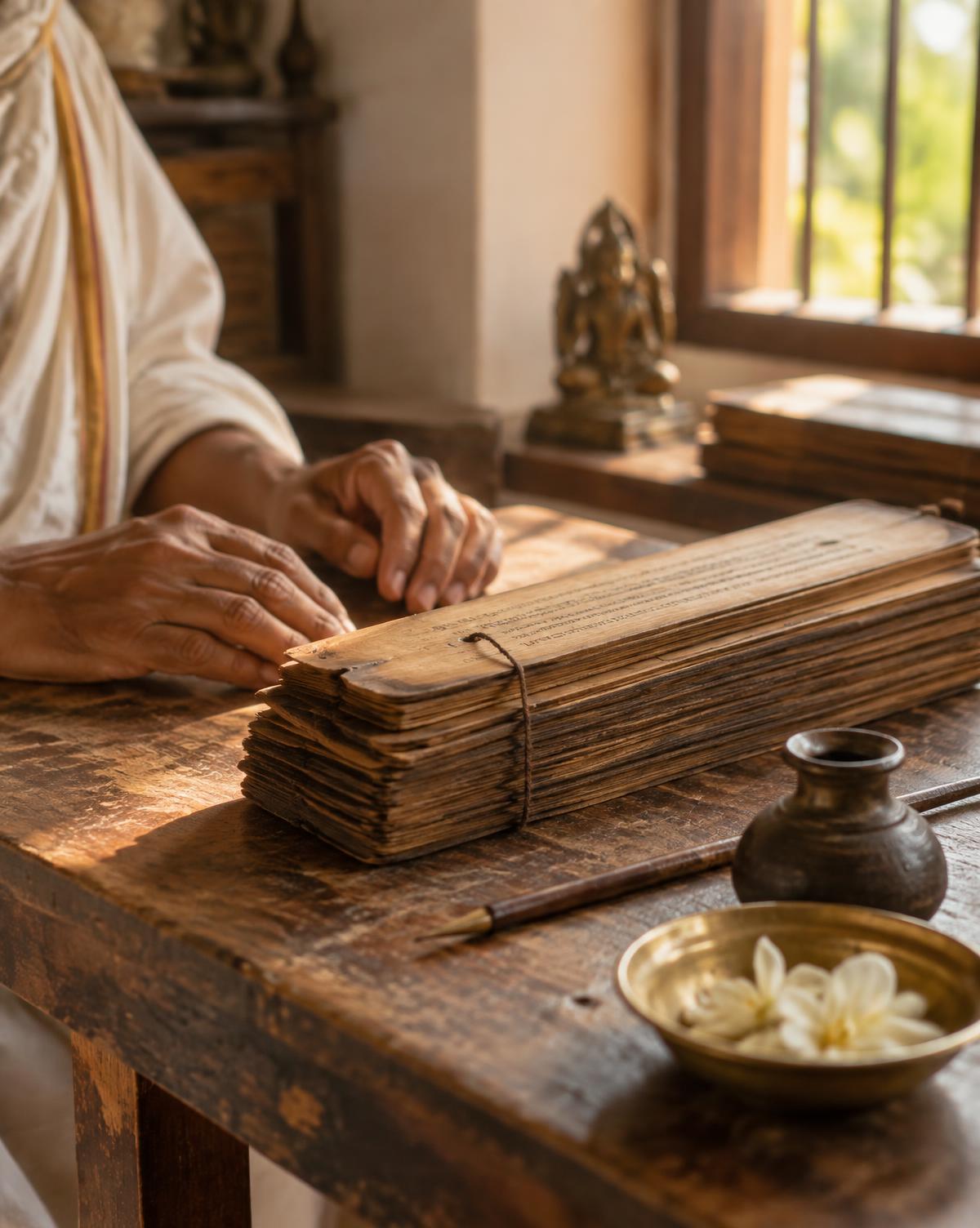
How do you preserve thousands of verses when every copy is scarce, vulnerable and capable of carrying an error forward? You do not leave memory to memory alone. You give it a method.
The argument
The problem before the page
A printed book makes repetition cheap. A digital file makes it almost effortless. But for much of human history, writing materials were perishable, copying was slow and every new manuscript introduced another opportunity for error. Knowledge that mattered could not depend only on an object surviving.
In India, one powerful answer developed around the Vedas. The Sanskrit word śruti — commonly rendered as ‘that which is heard’ — points to a body of revelation whose authoritative transmission was oral. A student did not simply learn what a verse meant. The sound itself mattered: syllable, sequence, pronunciation and Vedic accent had to be carried with unusual precision.
This is not a claim that India had no writing, or that every form of Indian knowledge travelled in the same way. Manuscripts existed and later worked alongside oral traditions. Epics, regional songs, craft knowledge, medical learning and philosophical argument moved through different mixtures of performance, instruction and text. The Vedic case is distinctive because fidelity of sound became an exacting discipline in its own right.
Memory was given a method
Training began through a relationship: a teacher voiced a passage and a student listened, repeated and was corrected. The guru–śiṣya setting mattered because an error was not left alone on a page. It was heard by another trained ear. Learning involved sustained rehearsal until the recitation could be produced accurately without a written prompt.
UNESCO describes Vedic chanting as using complex techniques based on tonal accents, pronunciation and combinations of sounds. Different recitation patterns could reorganise the same words — moving through them continuously, word by word, or in more elaborate forward-and-back sequences. Methods such as jaṭā and ghana pāṭha did more than make a performance intricate. By forcing the sequence to be reconstructed in multiple ways, they could expose a missing, misplaced or altered word.
Not every named recitation method should be projected back unchanged to the earliest Vedic period. These were traditions with histories, and scholars continue to study when particular forms took shape. The durable point is simpler: redundancy was built into transmission. A passage was not stored once. It was carried in voices, relationships and patterns that checked one another.
What survived — and what did not
The achievement is real, but it was not total. Vedic learning developed through śākhās: branches or recensions associated with particular lines of teaching. The Indira Gandhi National Centre for the Arts says that only ten of 1,131 traditionally enumerated recensions survive in an unbroken chanting tradition. That historical number should be understood as IGNCA's account, not as a modern census we can independently reconstruct. Its larger meaning is unmistakable: extraordinary fidelity within surviving lines did not prevent many lines from disappearing.
UNESCO's recognition of the tradition therefore carries two meanings at once. The chanting was proclaimed a Masterpiece of the Oral and Intangible Heritage of Humanity in 2003 and inscribed on the Representative List in 2008 because of the sophistication of its preservation. It also requires safeguarding because living traditions survive only while people continue to practise them.
A method can protect sound from alteration. It cannot guarantee teachers, students, institutions or social support forever. Preservation is not a victory completed in the past. It is work that each generation either continues or does not.
When manuscripts joined the conversation
The phrase ‘before books became ordinary’ describes a change of dependence, not a world without books. Writing and manuscripts were known in India, and Vedic manuscripts eventually recorded material transmitted orally. Yet writing could remain secondary to trained recitation: a manuscript might support study while the living voice retained authority over accent and sound that marks on a page could not fully reproduce.
Oral and written culture were not simple enemies. They overlapped. A manuscript could preserve, compare or travel; a reciter could embody distinctions that a damaged leaf or careless copy lost. The relationship changed across regions and centuries, and it should not be reduced to a neat story in which speech ended when writing began.
What carrying knowledge does to us
We now live with the opposite problem. Storage is abundant. A text can be found in seconds, duplicated without loss and forgotten just as quickly. This is not an argument against technology; access on this scale is an extraordinary good. But access and possession are different from internalisation.
The oral disciplines remind us that knowing can be an activity rather than a location. Repetition changes attention. Recitation makes the body answerable for the material. Correction makes knowledge relational. None of that requires us to imitate a Vedic training system, and memorisation alone does not create understanding. It simply reveals something our devices can obscure: what we carry within us is available differently from what we know how to retrieve.
Why it matters
Dharma Pitch editorial reflection
The history of oral transmission is not a tale of supernatural memory. It is a study in how communities designed disciplined, redundant methods around what they could not afford to lose.
Its limits matter as much as its successes: accuracy within a surviving lineage does not mean every lineage survived.
Source & Context
UNESCO's ‘Tradition of Vedic chanting’ describes oral transmission, tonal accents, pronunciation and complex sound combinations, and records the tradition's 2003 proclamation and 2008 inscription.
IGNCA documentation describes recitative methods including jaṭā and ghana pāṭha and reports that only a small number of historically enumerated śākhās remain in unbroken chanting traditions.
The account of manuscripts is deliberately qualified. Writing and manuscripts coexisted with oral practice; they did not simply replace it, and Vedic transmission should not be treated as a model for every Indian knowledge tradition.
Sources checked
Institutional descriptions of the living Vedic tradition were checked. Claims are limited to documented methods and do not imply perfect preservation, an absence of writing, or one uniform Indian oral system.
One question to carry with you
- 01
What do we lose when everything can be stored somewhere else and almost nothing has to be carried within us?