
Story · Upanishads
The Boy Who Came Home Knowing Everything
Shvetaketu had spent years studying. When he returned home, his father noticed something. His son was educated. But he had also become proud. So Uddalaka asked him one question. And suddenly, Shvetaketu realised how much he still did not know.
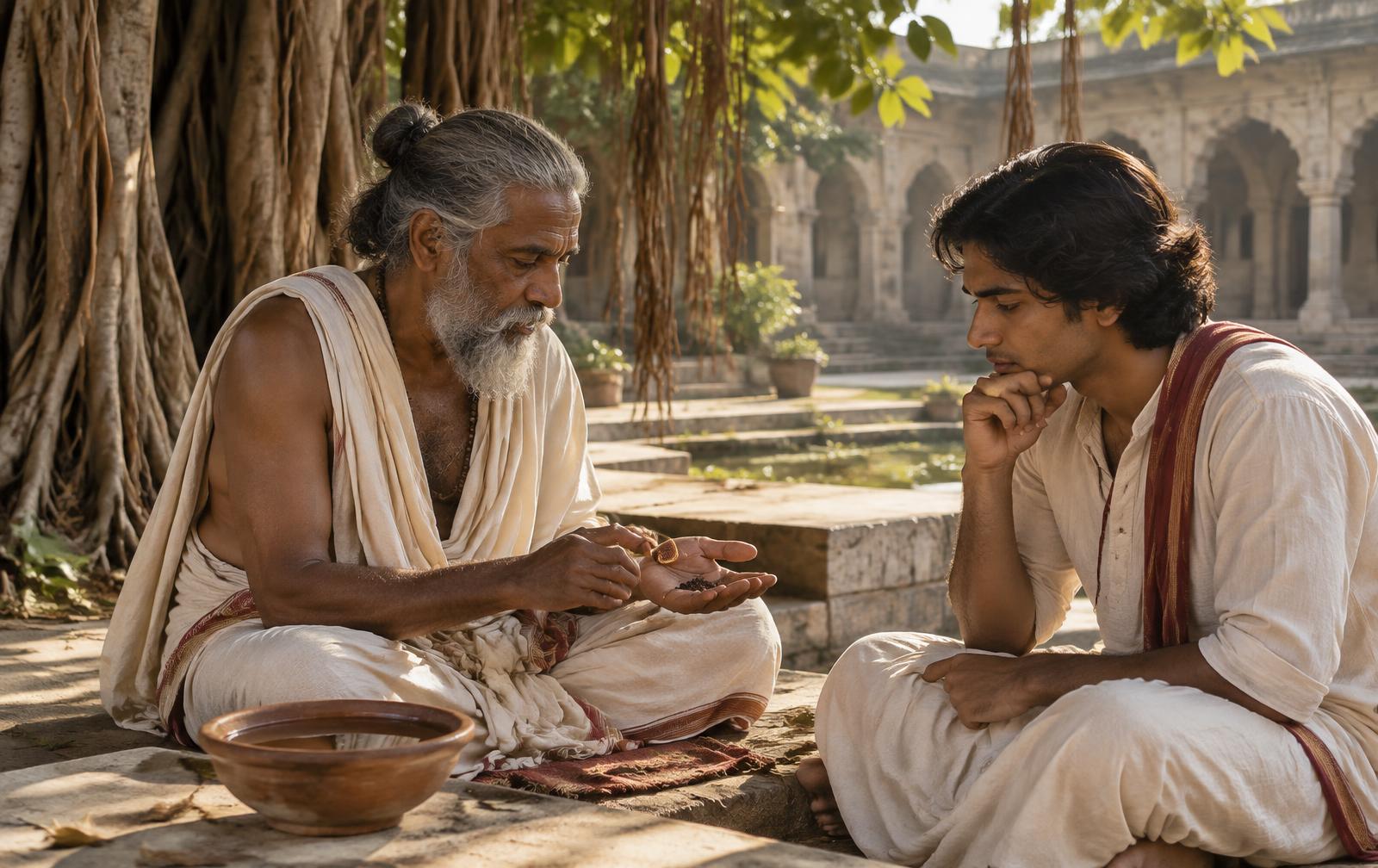
Shvetaketu returned after twelve years of study carrying the confidence of someone who believed his education was complete. His father did not dismiss what he had learnt. He asked whether it had reached the knowledge beneath it.
The story
Twelve years of learning
The Chandogya Upanishad tells us that Shvetaketu was twelve when his father, Uddalaka Aruni, sent him to study. He returned at twenty-four after learning the Vedas. The years had given him education, but they had also given him a settled opinion of himself. Depending on the translation, the text describes him as proud or conceited, thinking himself learned.
Uddalaka saw it. He did not begin by testing his son's memory. He asked whether Shvetaketu had sought the kind of instruction through which what had not been heard, thought or known could become understood. These formulations paraphrase the question rather than quote one translation.
Shvetaketu had no answer. He asked what such instruction could be, and invited his father to teach him. Twelve years of education did not end in a certificate of completion. They brought him to the point where learning could begin again.
Break the seed
Later in the teaching, Uddalaka asks Shvetaketu to bring the fruit of a nyagrodha, commonly identified as a banyan tree. He has him open the fruit and then break one of its tiny seeds. Shvetaketu can perceive nothing inside it.
Uddalaka directs his attention from what cannot be seen to what has grown from it: the vast tree. The teaching uses the subtle essence, imperceptible within the seed, to point towards what underlies the world and the self.
Something does not have to be visible to be fundamental. That sentence is Dharma Pitch's contemporary interpretation of the image, not a quotation from the Upanishad. The text's own argument belongs to the longer teaching sequence of Chapter 6 and should not be reduced to a modern lesson about appearances alone.
The salt
Uddalaka then gives Shvetaketu another exercise. Salt is placed in water and left overnight. By morning it can no longer be retrieved or seen as a separate object. Yet when Shvetaketu tastes the water from different places, the salt is present throughout.
The sequence makes the same philosophical pressure felt through another ordinary thing. What is not available to sight may still pervade what we experience. The point is not that salt scientifically proves a metaphysical claim. It is an analogy within Uddalaka's instruction, asking Shvetaketu to reconsider the limits of what the senses can immediately disclose.
Tat tvam asi
Across the teaching in Chapter 6, Uddalaka returns to the refrain tat tvam asi. It is conventionally rendered ‘That thou art’ or ‘You are That’. Each English version makes choices, and the compact Sanskrit has sustained centuries of interpretation.
Major Vedanta traditions do not agree on everything the statement means. Advaita reads it through non-duality; Vishishtadvaita and Dvaita interpret the relation between self and ultimate reality differently. The refrain belongs first to the Chandogya Upanishad. The developed school readings come later, and none should be quietly installed as the one uncontested meaning of the primary text.
Within the narrative, the refrain keeps returning to Shvetaketu personally. The lesson is not merely information about the structure of reality. The student who came home convinced of what he knew is repeatedly asked to understand where he himself stands in the teaching.
Education did not end. It began again
Shvetaketu's problem was not that he had studied too much. It was that information had begun to resemble completion. He possessed answers, and the possession had hardened into an identity: the person who knows.
That danger has not aged. Access to information is easier than it has ever been. An answer can arrive before a question has been properly formed. We can collect explanations, repeat them fluently and still avoid the slower work of understanding what they require us to reconsider.
Uddalaka does not humiliate education. He deepens it. Facts matter. Study matters. Memory and discipline matter. But genuine learning may also be recognised by what it does to certainty. It can make a person more precise, more attentive and less eager to mistake familiarity for understanding.
Shvetaketu came home educated. His education became alive again when he was able to say, in effect: I do not yet understand. Teach me.
Why it matters
Dharma Pitch editorial reflection
Knowledge and intellectual humility are not opposites. Humility is what keeps knowledge open to correction, depth and surprise.
The contemporary reflection here is Dharma Pitch's: education can enlarge what we know while also revealing the scale of what remains unknown. The second movement may be the more important one.
Source & Context
The primary source is Chandogya Upanishad Chapter 6. At 6.1.1–3, Shvetaketu is sent to study at twelve, returns at twenty-four described as learned and proud or conceited depending on translation, and is asked about the instruction through which the unheard, unthought and unknown become understood.
The nyagrodha fruit and seed instruction appears at 6.12.1–3. Nyagrodha is commonly identified as the banyan. The broken seed contains nothing perceptible to Shvetaketu; Uddalaka connects its subtle essence to the great tree.
The salt placed in water appears at 6.13.1–3. By the next day the salt cannot be separately retrieved, but its presence is discerned throughout the water by taste. This article keeps the example within Uddalaka's teaching sequence rather than presenting it as an independent proof.
Tat tvam asi recurs through the Chapter 6 instruction, including the refrain attached to the seed and salt passages. ‘That thou art’ and ‘You are That’ are conventional English renderings. Advaita, Vishishtadvaita, Dvaita and other interpretive traditions differ over its force; later Vedantic readings are distinguished here from the Upanishadic text and from Dharma Pitch's reflection.
No dialogue from a particular translation is quoted. Scene-setting is kept to what the text supports: Uddalaka asks for the nyagrodha fruit, without inventing a move outdoors or other surroundings.
Sources checked
- Chandogya Upanishad6.1.1–3; 6.12.1–3; 6.13.1–3
Checked against Chandogya Upanishad 6.1.1–3, 6.12.1–3 and 6.13.1–3. The narrative is paraphrased; conventional translations of tat tvam asi are identified as such; later Vedantic interpretations and Dharma Pitch reflection remain distinct.
One question to carry with you
- 01
When was the last time learning something made you less certain rather than more certain?