
Reflection · Dharma Pitch editorial
Ancient wisdom does not mean ancient answers
Why Dharma Pitch brings old questions into modern life, and why we will not pretend these texts contain solutions to problems they never encountered.
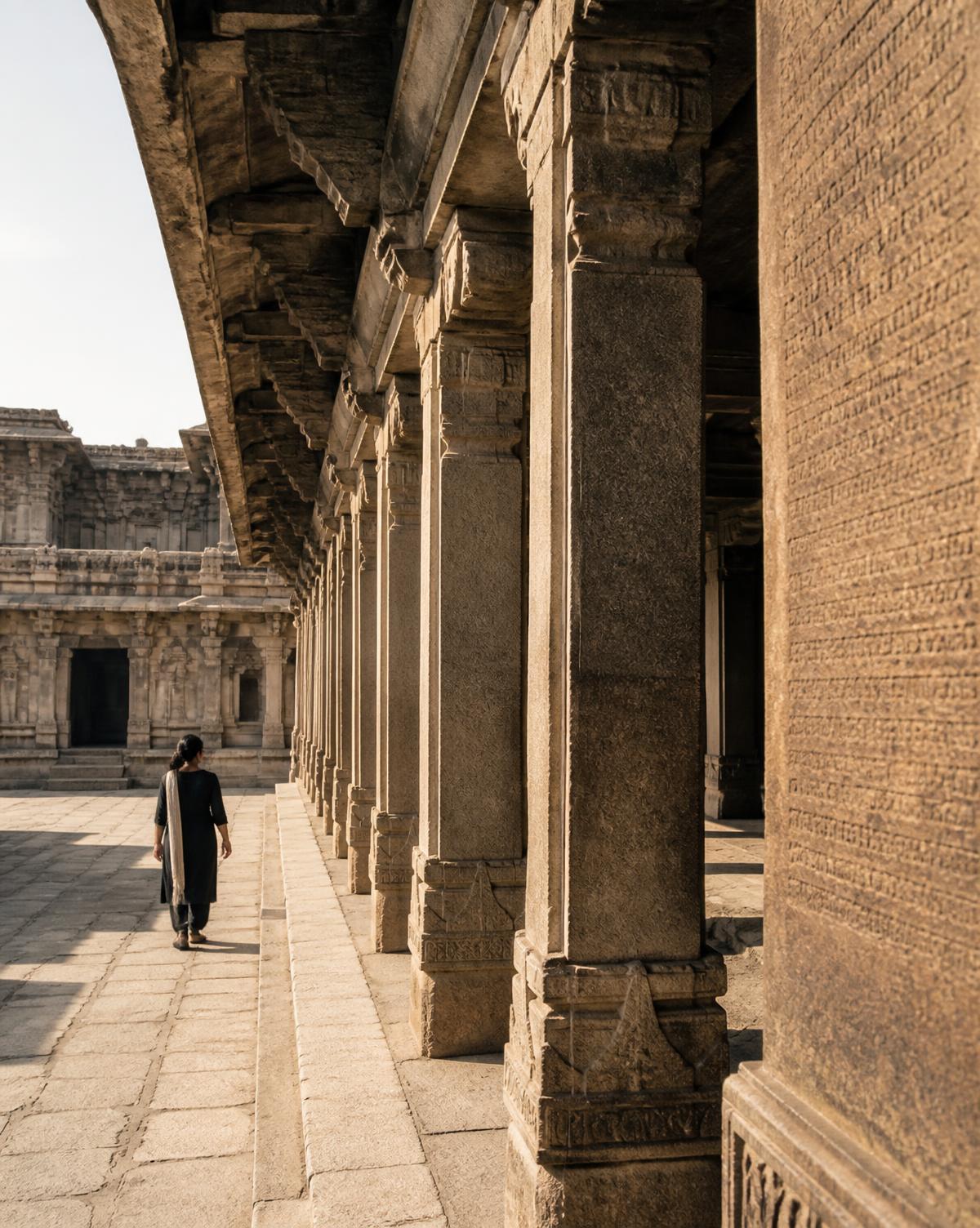
Age is not an argument. Neither is novelty. The interesting work begins when we stop treating either as one.
The reflection
Age is not an argument
A two-thousand-year-old idea is not automatically profound. It is also not automatically wrong, context-bound, or finished. Old age, in a text, is neither a credential nor a disqualification. It is simply a fact about when certain words were set down — and the interesting question is what those words do now, in front of a reader they were never written for.
The same caution runs the other way. Living later does not make us wiser. We know more about some things and have thought less carefully about others, and a century that solved problems its ancestors could not describe has also created problems its ancestors would have recognised instantly.
So we begin by refusing the two easiest positions available. The first says that ancient wisdom already contains every answer we need, and the reader's task is only to find the right verse. The second says these texts belong to another world entirely — interesting as heritage, irrelevant as thought. Both positions have one thing in common: neither requires an encounter. One decides in advance what the texts must say; the other decides in advance that they have nothing to say.
The space between reverence and interrogation
Dharma Pitch lives in the more difficult space between those positions, where the material is taken seriously enough to be questioned and questioned seriously enough to be understood.
Reverence alone flattens. It turns a civilisation's argumentative, varied, self-correcting inheritance into a single calm voice approving of whatever the reader already believed. Interrogation alone does something similar from the other side: it scans the past for confirmation that people have always been mistaken, which is a way of reading that learns nothing.
What we try to do instead is closer to what a good host does at a dinner where the guests disagree. The old text is given its say. The modern question is given its say. Neither is handed the floor permanently, and neither is protected from the other.
Reading without flattery
Reading responsibly, for us, starts small and stays small. Story before slogan: we tell what a text actually narrates before we say what it means. Source before certainty: we name where an idea comes from before we use it. And we keep the layers visible — what sits in a primary text, what arrives later as retelling or devotional tradition, and what is our own contemporary reading. Those three layers are distinguished in every piece on this site, because collapsing them is how invented quotations and convenient history get their start.
We also try not to tidy away disagreement. The Indian traditions we draw on argued with each other, extensively and in public, about the self, liberation, action and reality — and a reader deserves to know that, rather than being handed one school's position dressed up as a civilisation's unanimous verdict.
Where dating, authorship or wording is contested, we say so instead of smoothing it over. Where a beautiful detail is a later addition rather than an early narration, we let the later addition be late.
And the discipline cuts both ways. We do not smuggle modern psychology, management theory or political vocabulary into old texts to make them sound ahead of their time — nothing is gained by pretending Yama ran a leadership seminar. But neither do we freeze the texts in their historical display case. Interpretation is not a modern intrusion on these traditions; it has been one of the ways they have stayed alive for as long as we can trace.
What this looks like in practice
Take Shabari. Later tradition loved the detail of the tasted berries, offered with such devotion that Rama accepted them gladly. It is a moving story — and it is not what the Ramayana narrates, where Shabari's welcome and her guidance towards Pampa and Sugriva carry the weight. On this site you can love the later story and still be told which layer it belongs to.
Or take the self. Ask what Hinduism says about the atman and you will usually be handed one answer — but Advaita, Vishishtadvaita, Dvaita and Samkhya give materially different ones, and the Buddhist traditions denied the category altogether. The disagreement is not an embarrassment to be managed. It is where the thinking actually lives.
And Bhishma's terrible vow, honoured for a lifetime, ends up constraining everyone who depended on his judgement — including himself. A tradition that lets us revere the sacrifice and still examine its consequences is a tradition confident enough to be read honestly.
What we mean by modern questions
Modern questions, for us, do not mean asking a text to validate what we already believe. That is not a question; it is a rubber stamp.
We mean something more like: what happens when this old idea meets a problem we actually have? Sometimes the encounter leaves the text looking more penetrating than we expected. Sometimes it leaves the text looking bound to its moment. Sometimes it leaves us looking worse than we assumed — a story about a boy who refused every comfortable offer has an unnerving habit of finding the comfortable offers in a modern life.
The direction of the challenge is not fixed in advance. That is the whole point. If we knew before reading which side the text would land on, we would not need to read.
Some stories refuse to become old
There is a line we keep returning to: some stories refuse to become old.
We want to be careful with it, because said plainly enough it sounds like magic, and there is no magic in it. Stories survive for reasons that can be looked at. The human question inside them keeps returning — what is worth choosing, what we owe the people who raised us, what remains of us when everything changeable has changed — and each generation finds the question waiting, wearing new clothes.
Nachiketa standing in front of Death is not our contemporary, and the Katha Upanishad was not written to answer our anxieties. But the story puts a person in a room with the one offer everyone eventually accepts, and asks what they will refuse. A reader does not need to be ancient to be caught by that. The story is old; the grip is present tense.
Inheritance is not obedience
To inherit a tradition seriously is a demanding, unspectacular act. It means knowing the material well enough to question it without needing to destroy it, and valuing it without needing to sanitise it. Both shortcuts — the demolition and the varnish — are forms of disrespect. They both treat the inheritance as too fragile to survive contact with an honest reader.
We do not think it is fragile. A civilisation that preserved its texts through centuries of oral transmission, argued over them in royal assemblies, built schools on its disagreements and reinterpreted them in every century it touched can withstand being read carefully, quoted accurately and questioned openly.
So here is the editorial promise, said quietly rather than as policy: no fake quotations. No invented certainty. No later tradition hidden inside what looks like original scripture. No single school permitted to speak for the whole. No story forced to resolve into a motivational lesson it never contained. And when we get something wrong, we would rather correct it in public than quietly leave it standing.
Ancient wisdom. Modern questions.
That is the phrase we eventually arrived at, and it earns its keep only now that the terms are clear. Ancient wisdom is not a stockpile of answers awaiting retrieval. Modern questions are not a test the past must pass. The phrase describes a conversation with visible ground rules: the story arrives intact, the source is shown, the interpretation is labelled, and the reader is treated as capable of handling an open question.
Dharma Pitch is not here to tell you what to believe. We are here to make the encounter worth having — story intact, source visible, question open. What you conclude is genuinely yours.
Why it matters
Dharma Pitch editorial reflection
The quality of the bridge determines what ancient material becomes: living thought, or decorative nostalgia.
Old texts used as slogans stop being read — and unread texts cannot surprise anyone.
Showing the method lets the reader audit it. Where interpretation begins is always visible here, and the reader decides whether it persuades them.
Source & Context
This essay is a Dharma Pitch editorial position, not a reading of any particular ancient text. It quotes nothing and cites no verses.
The examples it draws on point back to source-checked pieces in this library: Shabari's hospitality and the berry tradition in Shabari and Rama; the differing schools on the self in What is the atman and What is moksha; the vow and its consequences in Dharma: when every choice is wrong; and the refusal of Yama's offers in Nachiketa and Yama.
The layering described here — primary text, later tradition, contemporary reading — is applied in every piece on this site, and marked where verification is still pending.
A Dharma Pitch editorial statement rather than an account of any source text. It quotes nothing and makes no textual claims; its examples link to source-checked articles.
What it raises
- 01
What is the difference between a text that is relevant and a text that is being made to be relevant?
- 02
If interpretation has always been part of these traditions, what distinguishes reading them from rewriting them?
- 03
What would you need to see before trusting a publication that claims to speak for a whole civilisation?
Explore further
Dharma
The word we are most often asked about, and the clearest case of why a single translation will not serve.
Read the entryDecision-making
Our contemporary framework, and an example of how we label our own work as ours.
Read the entryReading the sources
An orientation to how the Upanishads are layered, transmitted and interpreted.
Read the entry