
Story · Mahabharata
The Woman Who Asked a King If He Was Really Free
King Janaka was known as a man who could rule a kingdom without being ruled by it. Then Sulabha came to his court. Not to ask for wealth. Not to seek favour. But to test an idea. Was the king who spoke of liberation truly free?
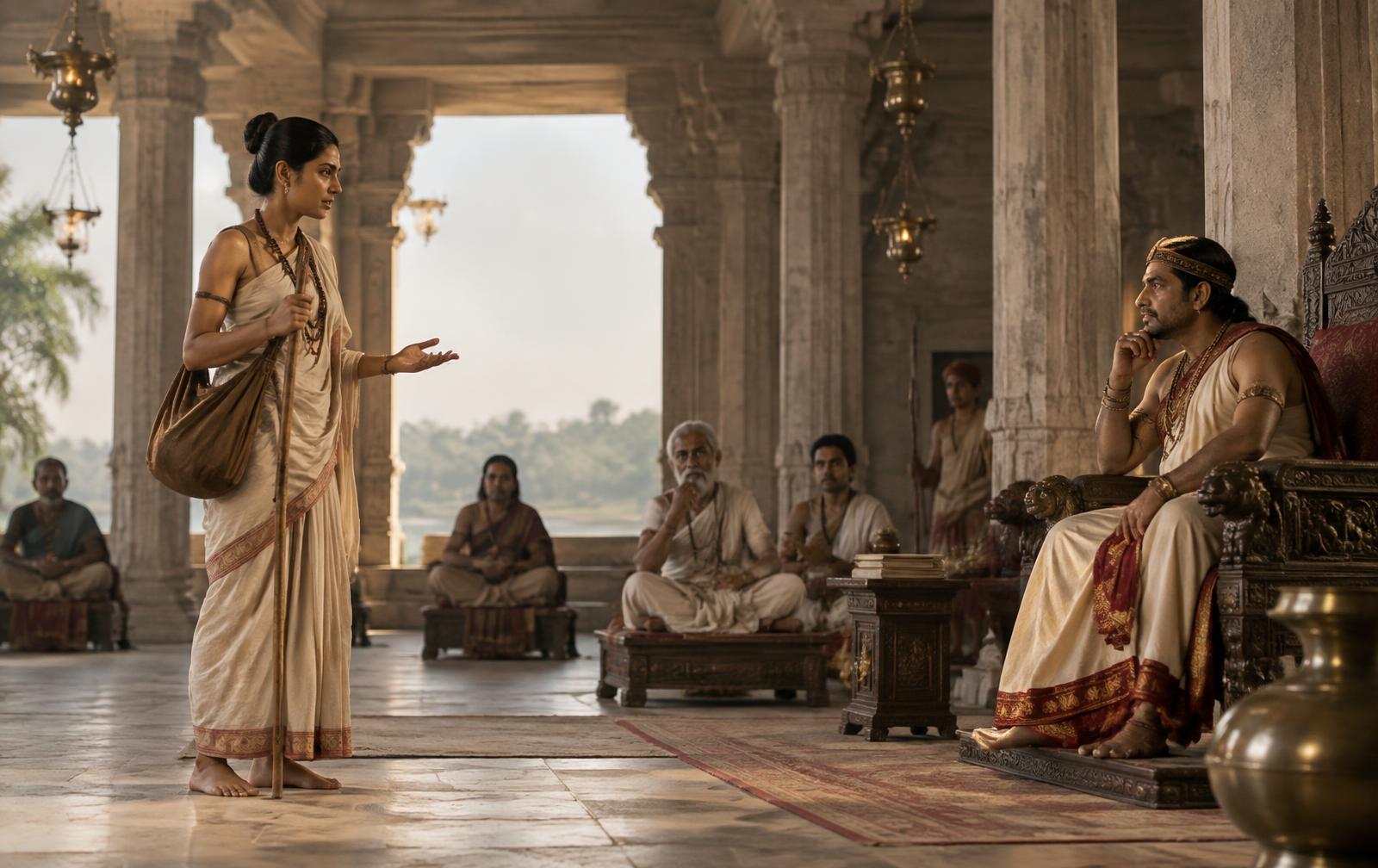
It is easy to speak of detachment when nothing we call ours is being tested. Sulabha entered Janaka's court to examine what freedom meant when authority, identity and possession were no longer abstract ideas.
The story
The king who claimed detachment
The Mahabharata preserves a remarkable philosophical encounter between King Janaka and a wandering woman ascetic named Sulabha. Janaka was no ordinary ruler. He spoke of knowledge, renunciation and liberation while continuing to govern a kingdom. His position raised an important possibility: could someone remain surrounded by power and responsibility, yet inwardly remain unattached?
Sulabha had heard of Janaka's reputation, so she travelled to Mithila. The text presents her as an accomplished renunciant. She entered Janaka's court alone, and Janaka received her. But what followed was not an ordinary conversation. It became an examination of identity itself.
Sulabha's challenge
Janaka set out his understanding of liberation and the discipline through which he believed freedom could coexist with kingship. His response also turned towards Sulabha. Who was she? Where had she come from? Why had she approached him?
Sulabha's answer moves the discussion somewhere deeper. She challenges the assumptions carried by questions of identity, status and possession. If the body continually changes, if experience arises through interacting qualities and conditions, and if liberation loosens ordinary identification, what exactly does it mean to insist on a fixed ‘you’ and ‘I’?
Her argument probes a tension in Janaka's position. A person may speak of detachment. But when someone enters my court, questions my understanding or crosses a boundary I consider mine, does the sense of possession return? This is not invented dialogue, but a contemporary paraphrase of the philosophical pressure within their exchange.
Freedom is harder when something is yours
This is where an ancient debate becomes unexpectedly modern. It is relatively easy to believe we are detached when nothing important is being challenged. The real test comes when the challenge reaches something we identify with: a title, expertise, reputation, authority or belief.
Sulabha does not simply ask Janaka what he knows. Through their encounter, she forces a more uncomfortable question: what are you still attached to while believing yourself free?
The Mahabharata does not need to be reduced to a simple story of a woman defeating a man, or an ascetic defeating a king. Its question is more enduring than that. We can understand freedom intellectually, speak beautifully about detachment and even teach it, then discover that somewhere inside us sits a quiet word: mine.
Perhaps freedom begins when we notice it.
Why it matters
Dharma Pitch editorial reflection
There is external freedom, and there is internal freedom. The two are not always the same. Someone may possess very little and remain deeply attached; someone may carry enormous responsibility and remain inwardly unattached.
The Janaka–Sulabha dialogue asks us to examine the difference rather than assume it. Dharma Pitch's contemporary reading begins there; it is not presented as the only meaning of the episode.
Source & Context
The primary source is the Mahabharata's Shanti Parva, within its Mokshadharma material. Chapter numbering varies materially across editions and translations, so this article identifies the episode rather than presenting one edition's numbering as universal.
The dialogue belongs to the Mahabharata's larger discussion of liberation, knowledge, renunciation and conduct. Sulabha's arguments are philosophically complex and have received different interpretations.
The episode is not presented here as proof that Sulabha ‘defeated’ Janaka, that Janaka was fraudulent, or that one modern gender or political reading settles its meaning. Janaka's position is treated as a philosophical claim under examination, not as a simple boast.
The account separates the text's argument from later scholarly interpretation and from Dharma Pitch's contemporary framing about identity, authority and the things we call ours. No dialogue is invented.
Sources checked
- Mahabharata, Shanti Parva — MokshadharmaSulabha–Janaka dialogue; chapter numbering varies by edition
Based on the Sulabha–Janaka dialogue in the Mahabharata's Shanti Parva. Edition-dependent numbering is deliberately not fixed; textual argument, later interpretation and Dharma Pitch reflection remain distinct.
One question to carry with you
- 01
What are you still protecting as ‘mine’ while telling yourself you have let it go?