
Story · Upanishads
The King Who Found Wisdom Under a Cart
Janasruti had wealth, influence and a reputation for generosity. Then one night, he heard a name he had never heard before. Raikva. And suddenly, everything he thought he knew about achievement was unsettled.
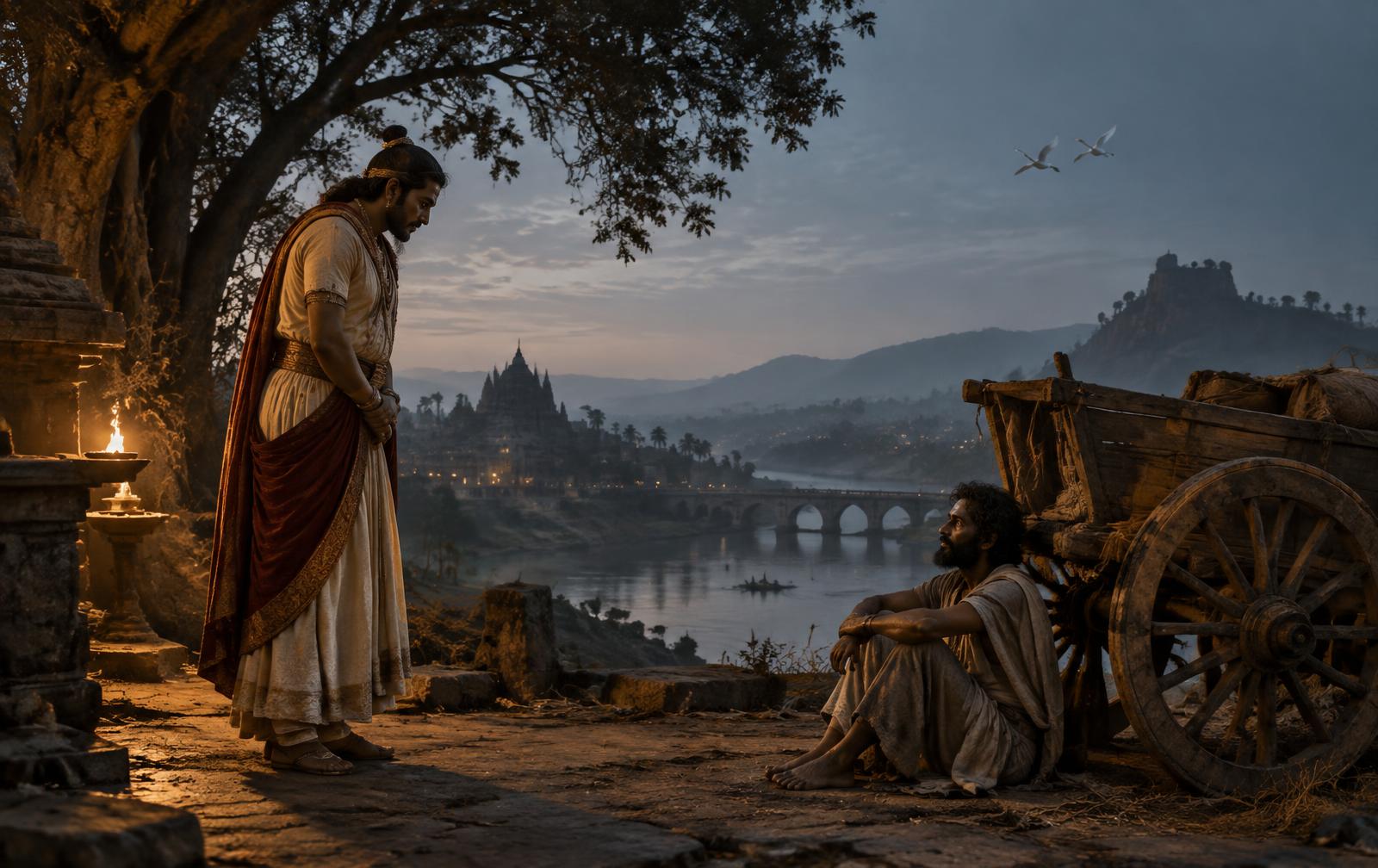
Janasruti was known for what he gave. What unsettled him was hearing that an unknown man beneath a cart possessed something his achievements had not yet brought him.
The story
A king known for giving
The Chandogya Upanishad introduces Janasruti Pautrayana as a ruler renowned for his generosity. Food was prepared in abundance. Rest houses were established in different places so travellers could eat and find shelter. His reputation had travelled far.
One night, Janasruti overheard an extraordinary conversation. Swans were flying overhead. One warned another not to come too close to Janasruti's radiance, describing it as spreading across the sky. But the other answered by invoking someone else: Raikva with the cart.
The comparison disturbed Janasruti. Who was Raikva? And what did this unknown man possess that a powerful and generous ruler did not?
The search
Janasruti sent someone to find him. The first search failed. Eventually, Raikva was discovered in an unlikely place — sitting beneath a cart and scratching himself.
There was no palace, no visible position of power, no grand institution announcing that a great teacher lived there. Yet this was the man whose knowledge had been spoken of with such extraordinary regard.
Janasruti went to him carrying six hundred cows, a gold ornament and a mule-drawn chariot. Raikva did not simply accept the offer and begin teaching. Janasruti returned with a greater offering. Eventually, the encounter became one of teacher and seeker, and Raikva began to teach.
What Raikva knew
The teaching that follows is known as Samvarga Vidya — a teaching centred on samvarga, often rendered as absorption or that into which things are gathered.
Raikva points towards Vayu, air or wind, in the cosmic sphere. When fire goes out, the text says, it goes into air. When the sun and moon set, they enter into air. When water dries, it goes into air.
He then turns towards the human being. During sleep, speech, sight, hearing and mind are described as becoming gathered into prana, the vital breath or life-principle. The Upanishad is doing something characteristic of its philosophical method: drawing a correspondence between the world outside us and the life within us.
The teaching belongs to a much larger Upanishadic conversation. But before the formal instruction even begins, the story has already staged another kind of lesson.
The person who knows may not look important
Janasruti is not portrayed as a bad ruler. Quite the opposite. He was generous. He fed people. He used what he possessed for others. Yet his goodness had not made his learning complete. When he discovered that someone knew something he did not, he went looking.
That may be the most human part of the story. Success creates a subtle danger: the more accomplished we become, the easier it is to assume that wisdom will come from people who look accomplished too. We expect the teacher to have the title, the office, the audience and the visible markers of authority.
Janasruti went searching for a person of extraordinary knowledge. He found him under a cart.
Why it matters
Dharma Pitch editorial reflection
Achievement and wisdom are not necessarily the same thing. Janasruti already had wealth, status and a record of generosity. His next step did not come from acquiring more; it came from discovering that there was still something he did not know.
There is strength in accomplishment. There may be even greater strength in remaining teachable after accomplishment arrives.
Source & Context
The primary source is the Chandogya Upanishad 4.1–4.3, a text associated with the Sama Veda. It describes Janasruti's generosity, the conversation of the swans, the search for Raikva, Raikva being found beneath or with a cart, Janasruti's offerings and the teaching generally known as Samvarga Vidya.
‘Raikva the cart-driver’ is a common modern description, but the Sanskrit designation is more cautiously rendered as ‘Raikva with the cart’ (Raikva Sayugvan). The text describes him beneath a cart; it does not straightforwardly establish cart-driving as his occupation.
Raikva also addresses Janasruti using the word shudra during their encounter. Commentators interpret its use here differently. This episode is therefore not presented as evidence for one settled claim about Janasruti's social identity or about caste.
Later Vedantic commentaries offer explanations of the episode that must be distinguished from the wording of the Upanishad itself. The narrative here paraphrases the primary text without adding dialogue.
Sources checked
- Chandogya Upanishad4.1.1–8; 4.2; 4.3.1–3
Checked against Chandogya Upanishad 4.1–4.3. The primary narrative, later commentary and Dharma Pitch's contemporary reflection are kept distinct; disputed interpretations of shudra are not presented as settled fact.
One question to carry with you
- 01
When you want to learn, are you searching for wisdom — or for someone who looks like your idea of a wise person?