
Story · Upanishads
The Woman Who Asked What Wealth Could Never Buy
Yajnavalkya was preparing to leave his household life. Before leaving, he intended to divide his property. Then Maitreyi asked him a question. If all the wealth in the world were mine — would it make me immortal? His answer was no. And Maitreyi's response changed the conversation completely.
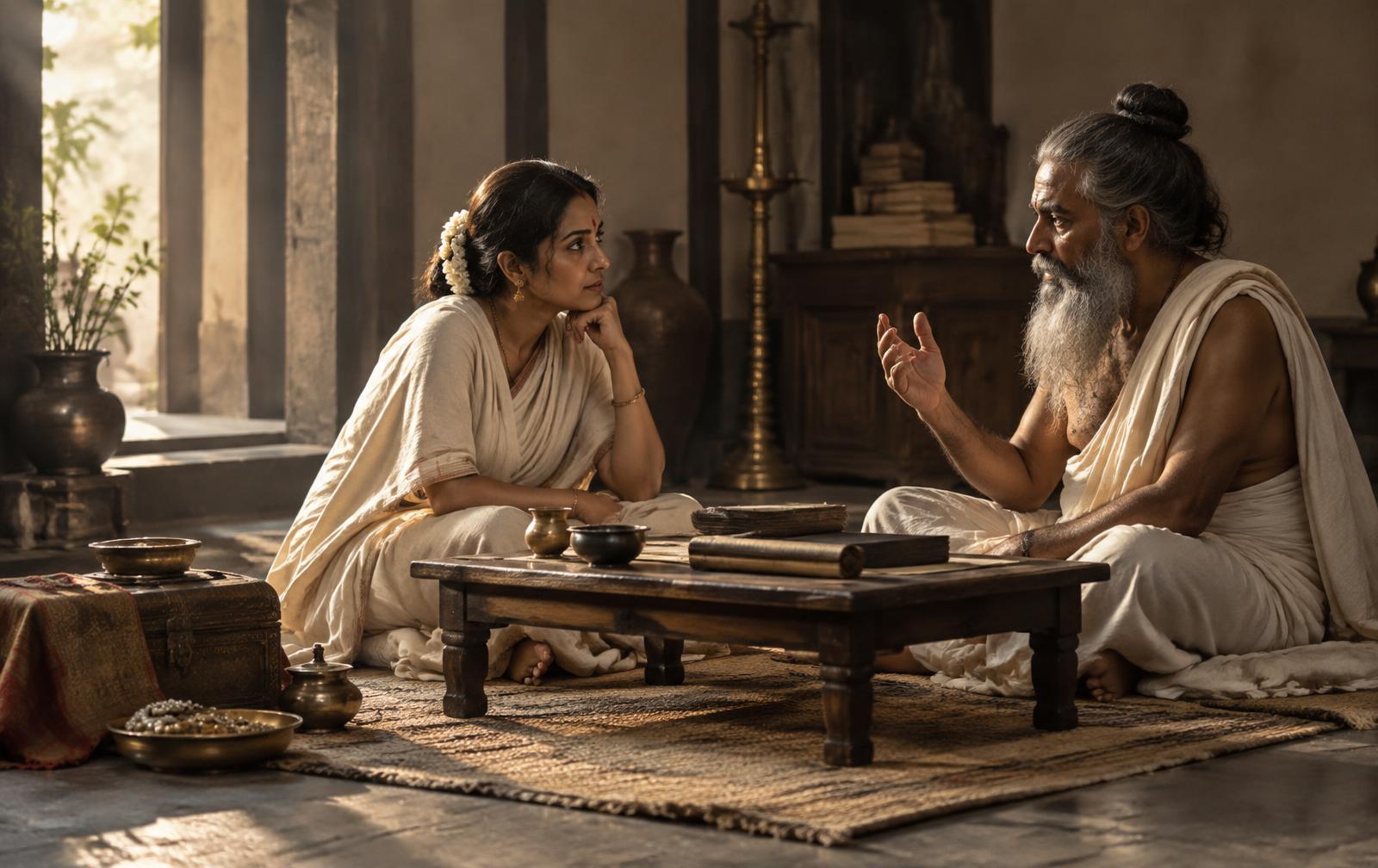
Maitreyi did not ask how much wealth she would receive. She asked what wealth was capable of giving — and whether it could answer the question that mattered most to her.
The story
The offer
The Brihadaranyaka Upanishad preserves a conversation between the sage Yajnavalkya and Maitreyi. Yajnavalkya tells her that he intends to leave his present household life and make arrangements concerning his property between Maitreyi and Katyayani.
Maitreyi does not begin by asking how much she will receive. Instead, she poses a hypothetical question: if the whole earth, filled with wealth, belonged to her, would that make her immortal?
Yajnavalkya tells her it would not. She could live as wealthy people live, but wealth would not give her immortality. Maitreyi sees the implication immediately. Once told that property cannot yield what she ultimately seeks, she asks Yajnavalkya to teach her the knowledge he considers relevant to immortality.
A different question about wealth
It would be easy to reduce the exchange to a slogan: money does not matter. But that is not what the dialogue says. Yajnavalkya does not claim that wealth cannot provide comfort, security or material possibility. His answer acknowledges the kind of life available to those who possess plenty.
Maitreyi asks something more precise: what is this capable of giving me? And what am I asking it to give me that it cannot? That distinction matters.
Wealth can solve many problems. Confusion begins when we ask one thing to perform a function it was never capable of performing. Status cannot guarantee meaning. Recognition cannot guarantee self-knowledge. Possessions cannot prevent mortality. One of life's harder disciplines may be learning which tool belongs to which question.
What are you actually seeking?
After Maitreyi asks for knowledge rather than an account of property, Yajnavalkya begins one of the Brihadaranyaka Upanishad's profound explorations of the Self. The conversation moves far beyond money. It asks why we love, what the Self is, and what remains when ordinary distinctions are examined at their deepest level.
Different Vedanta traditions have developed sophisticated interpretations of these passages. Those later readings matter, but they should not be mistaken for the primary text speaking with one uncontested voice.
Before all of that philosophy comes one remarkably clear moment. A woman is offered wealth. She asks what it can ultimately do. She hears the answer and changes the question.
Perhaps that is Maitreyi's gift to us. Not whether we should want wealth, but what we are really trying to obtain through the things we want. Those are very different enquiries.
Why it matters
Dharma Pitch editorial reflection
There is nothing inherently spiritual about rejecting money, and nothing inherently wise about accumulating it. The deeper question is whether we understand its limits.
Every pursuit has something it can give us and something it cannot. Confusion begins when we ask the temporary to provide what we believe should be permanent.
Source & Context
The primary source is Brihadaranyaka Upanishad 2.4. A closely related version of the Maitreyi–Yajnavalkya dialogue appears at 4.5.
At 2.4.1, Yajnavalkya announces his intention to leave the household state and settle matters between Maitreyi and Katyayani. At 2.4.2–3, Maitreyi asks whether an earth filled with wealth could make her immortal, is told no, and asks to learn what Yajnavalkya knows.
The subsequent teaching on atman has an extensive interpretive history, including influential Advaita readings. This article distinguishes the primary text from later commentary and from Dharma Pitch's contemporary reflection.
The phrase ‘chooses knowledge over property’ can make the encounter sound like a modern transaction. More precisely, once told that wealth cannot yield immortality, Maitreyi asks for the knowledge Yajnavalkya considers relevant to it. The dialogue is paraphrased here rather than quoted.
Sources checked
- Brihadaranyaka Upanishad2.4.1–3; related dialogue at 4.5
Checked against Brihadaranyaka Upanishad 2.4.1–3, with the related dialogue at 4.5 noted. The primary exchange, later Vedantic commentary and Dharma Pitch reflection remain distinct; no translation is quoted.
One question to carry with you
- 01
What are you asking success to give you that success may never be able to provide?