
Deeper read · Upanishads
The Gods Won. Then a Blade of Grass Exposed Them.
The devas won a great victory and credited themselves for it. Then a mysterious being appeared, and one blade of grass was enough.
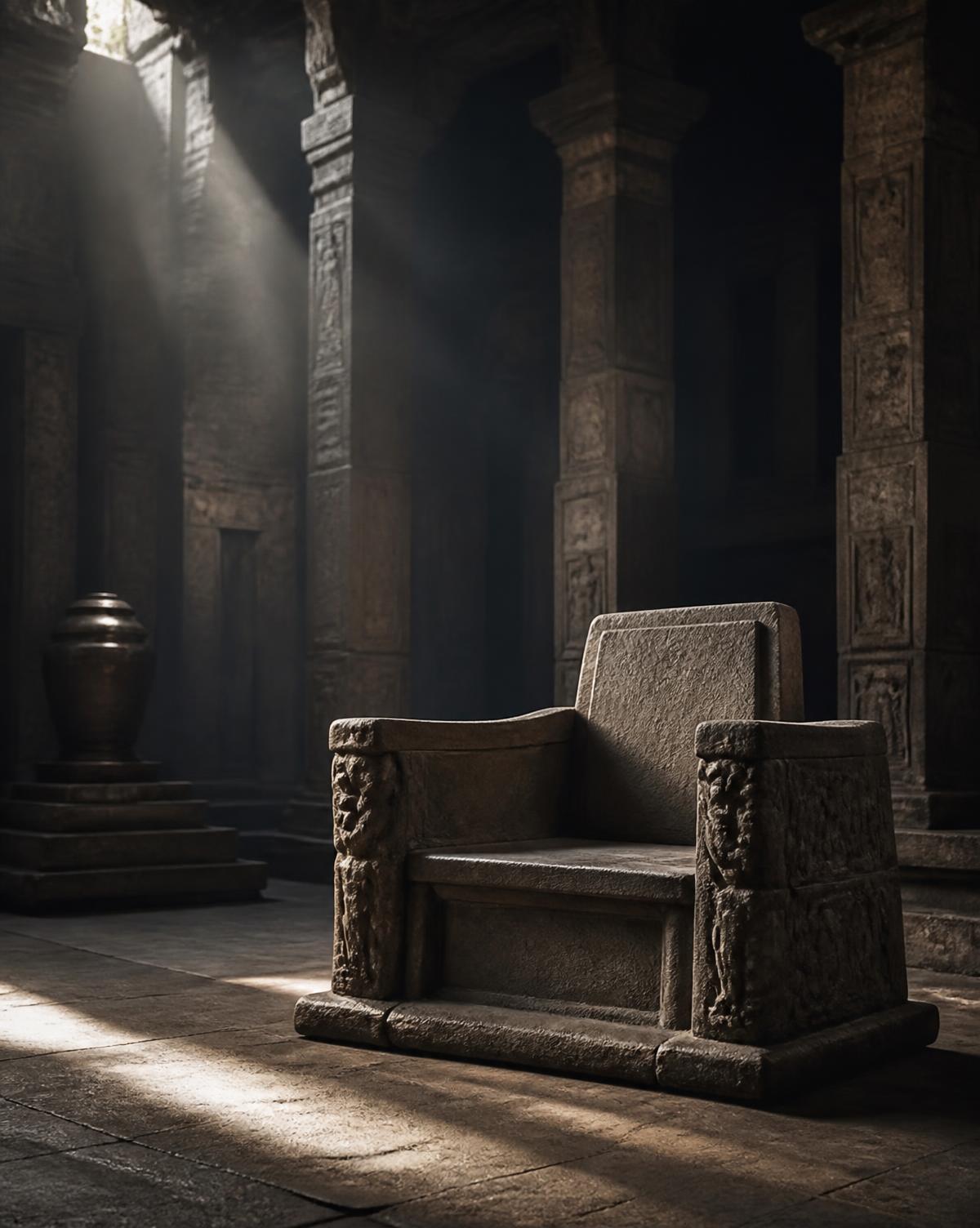
The gods had won. And almost immediately, they made a mistake.
The story
The victory
The gods had won. And almost immediately, they made a mistake. They began to believe the victory belonged to them.
The Kena Upanishad tells this in a few spare lines. Brahman had secured a victory for the devas. But the devas looked at the result and thought, in effect: this is our victory; this is our greatness.
The text's own conclusion is precise: the victory belonged to Brahman; the devas had attained greatness through it.
Then something unfamiliar appeared before them — a mysterious Yaksha. The devas did not know what it was.
Agni
So they sent Agni. The Yaksha asked who he was and what power he possessed. Agni identified himself and said he could burn everything on earth.
The Yaksha placed a blade of grass before him. Burn it.
Agni tried. He could not. Fire returned without knowing who the stranger was.
Vayu
Then Vayu went. He too was asked what he could do. Vayu said he could carry away everything on earth.
The same blade of grass was placed before him. Move it.
Vayu could not. He returned without an answer.
Indra
Finally Indra approached. But before Indra could discover the Yaksha's identity, it vanished.
In the same space, Indra encountered a radiant woman whom the text names Uma Haimavati. He asked her who the mysterious being had been.
Her answer changes the meaning of the gods' victory: it was Brahman. Their triumph had depended on a reality they had failed even to recognise.
The small thing that exposed the big claim
There is something almost playful about the Kena's choice of test. Agni is not asked to burn a mountain. Vayu is not asked to move an ocean. One blade of grass is enough.
The point is not that fire has suddenly stopped being fire or wind has stopped being wind. Agni really is fire. Vayu really is wind. Their power is not imaginary. Their mistake is subtler.
It is the confusion between having power and being its source — between acting greatly and being the ground of action. And that distinction becomes easiest to forget immediately after success.
A team delivers something extraordinary. A leader receives the applause. A business grows. An artist creates something people love. A person survives something difficult.
And quietly, 'this happened through me' can become 'this happened because of me alone.'
Why Indra learns
Agni fails. Vayu fails. Indra does not conquer the mystery either. What distinguishes Indra is that after the Yaksha disappears, he encounters Uma Haimavati and asks. He receives knowledge.
The text subsequently places Indra foremost among these devas because he came nearest and was first to know that the Yaksha was Brahman.
Perhaps the most interesting thing about the most powerful figure in the scene is therefore not his power. It is that he still had to be told.
And what he had to be told concerned things we did not choose and cannot command: the faculties themselves, the bodies we did not give ourselves.
Success can prove capability. It cannot prove that we understand the source of everything that made our capability possible. Sometimes one blade of grass is enough to remind us.
The Danger of Mistaking Power for Ownership
Dharma Pitch editorial reflection
Humility does not require pretending that you contributed nothing. It asks something harder: to see your contribution accurately without confusing it with the whole cause.
The Kena does not deny that Agni burns or that Vayu moves. It asks what made the burning and the moving possible in the first place — and warns that the confidence of having just succeeded is precisely when that question goes unasked.
The modern leadership reading — of credit after victory, of mistaking position for source — is Dharma Pitch's editorial reflection, not a management teaching the Upanishad states.
Source & Context
Primary text: Kena Upanishad, traditionally transmitted with the Sama Veda. The narrative begins in section 3: Brahman wins the victory for the devas; they attribute the victory and glory to themselves; Brahman appears as an unidentified Yaksha. Agni is unable to burn a blade of grass (3.3–3.6), Vayu is unable to carry it away (3.7–3.10), and Indra approaches before the Yaksha disappears (3.11–3.12). At 3.12 Indra encounters 'Uma Haimavati', described as a greatly resplendent woman, and asks who the Yaksha was. At 4.1 she identifies it as Brahman and explains the devas' victory in relation to Brahman. Sections 4.2–4.3 distinguish Agni, Vayu and especially Indra by their proximity to and knowledge of Brahman.
The received text says only 'Uma Haimavati'. Identifying her with Parvati, daughter of Himavat, or reading Uma as personified knowledge (vidya), belongs to later commentarial tradition, including Shankara's commentary. Those readings are labelled as interpretation here, not presented as wording of the passage.
Allegorical mappings of Agni, Vayu and Indra onto specific psychological faculties are likewise interpretation, not the text's explicit claim.
This is a Dharma Pitch retelling in plain English; nothing is quoted as translation.
Sources checked
- Kena UpanishadSections 3.1–3.12 and 4.1–4.3
An editorial retelling checked against the Yaksha episode of the Kena Upanishad (sections 3.1–3.12 and 4.1–4.3). The text names Uma Haimavati; identifications of Uma and allegorical readings of the devas are labelled as later interpretation. Nothing is quoted as translation.
One question to carry with you
- 01
When something goes brilliantly in your life, how much of the story do you instinctively make about yourself?
Explore further
Brahman
The Kena points behind the powers that act. The question of what remains beneath changing identity is explored in the Atman entry.
Read the entryAgency
Karma is not a scoring system — and the doer is not always who the applause assumes.
Read the entryHumility after success
The hardest version of humility is the one required at the moment of victory.
Entry in preparation