Dhruva was a young prince who wanted something very simple. He wanted to sit on his father's lap.
One day, he saw his younger brother there and walked towards the king. But Dhruva's stepmother, Suruchi, stopped him. Her words were cruel. She told Dhruva that he did not have the right to take that place.
Dhruva was deeply hurt.
He ran to his mother, Suniti. Why could he not sit beside his father? Why should someone else decide that he did not belong?
Suniti comforted him as best she could, but Dhruva's hurt had already turned into determination. He wanted a place that nobody could take away.
So the young boy left the palace.
In the forest, Dhruva met the sage Narada. Narada saw the anger and pain inside him. He also saw something else. Once Dhruva decided to do something, he did not give up easily.
Narada guided him towards Vishnu and taught him how to focus his mind.
Dhruva began a difficult period of meditation. Days passed. Then more. The child who had entered the forest thinking about a place on his father's lap became absorbed in something far greater than the palace he had left behind.
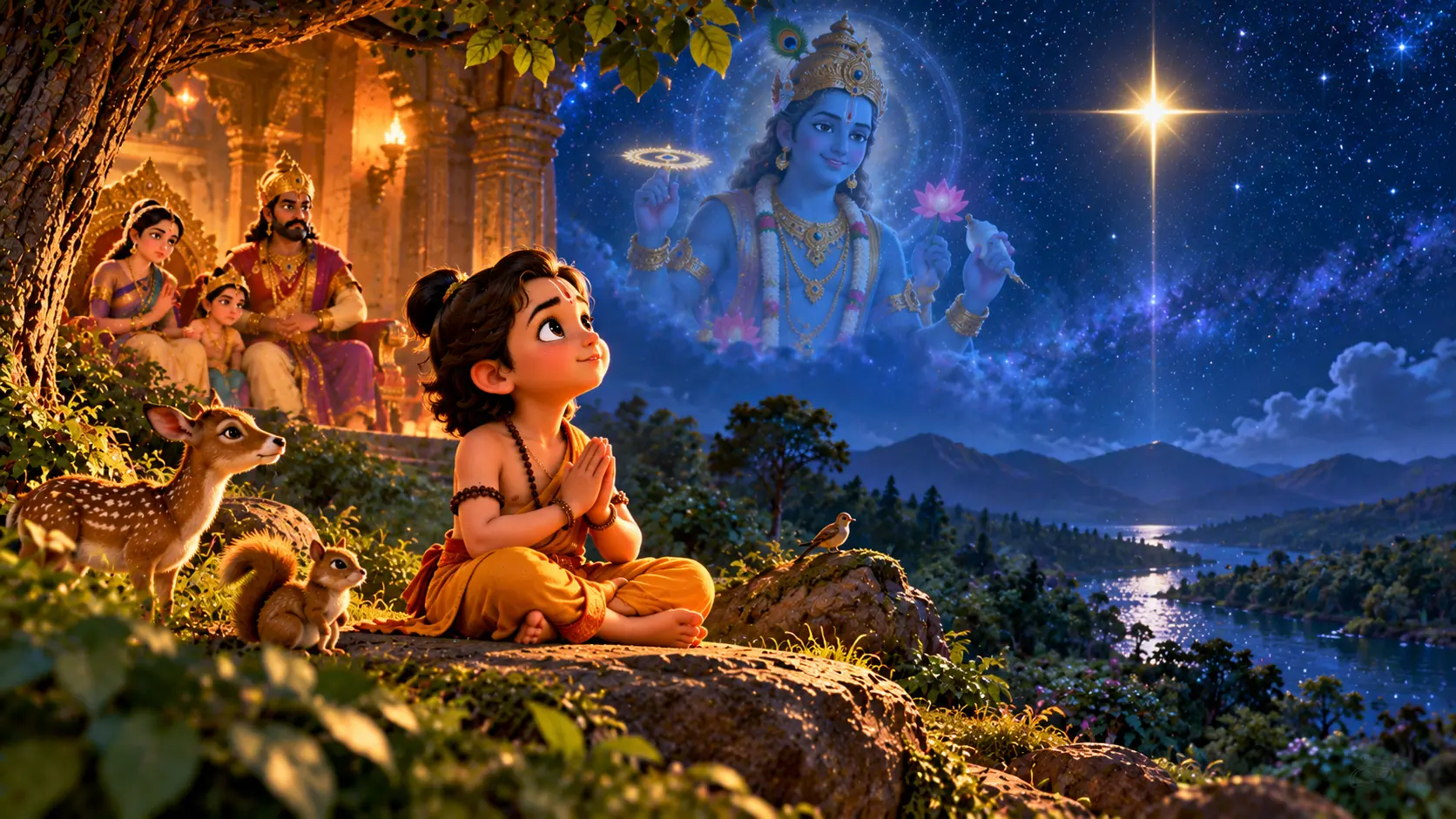
Eventually, Vishnu appeared before him.
Dhruva had begun his journey wanting recognition. But standing before Vishnu, the thing he had once wanted so desperately no longer seemed quite as enormous. His journey had changed him.
The story eventually connects Dhruva with a special place in the heavens — the fixed point around which the stars appear to turn. We know it as the pole star. In India it came to be called Dhruva Tara.
There is something beautiful about that. A child had left home desperately searching for a place nobody could take from him. And generations remembered him by looking towards a star that seemed to stay steady while the night sky moved around it.